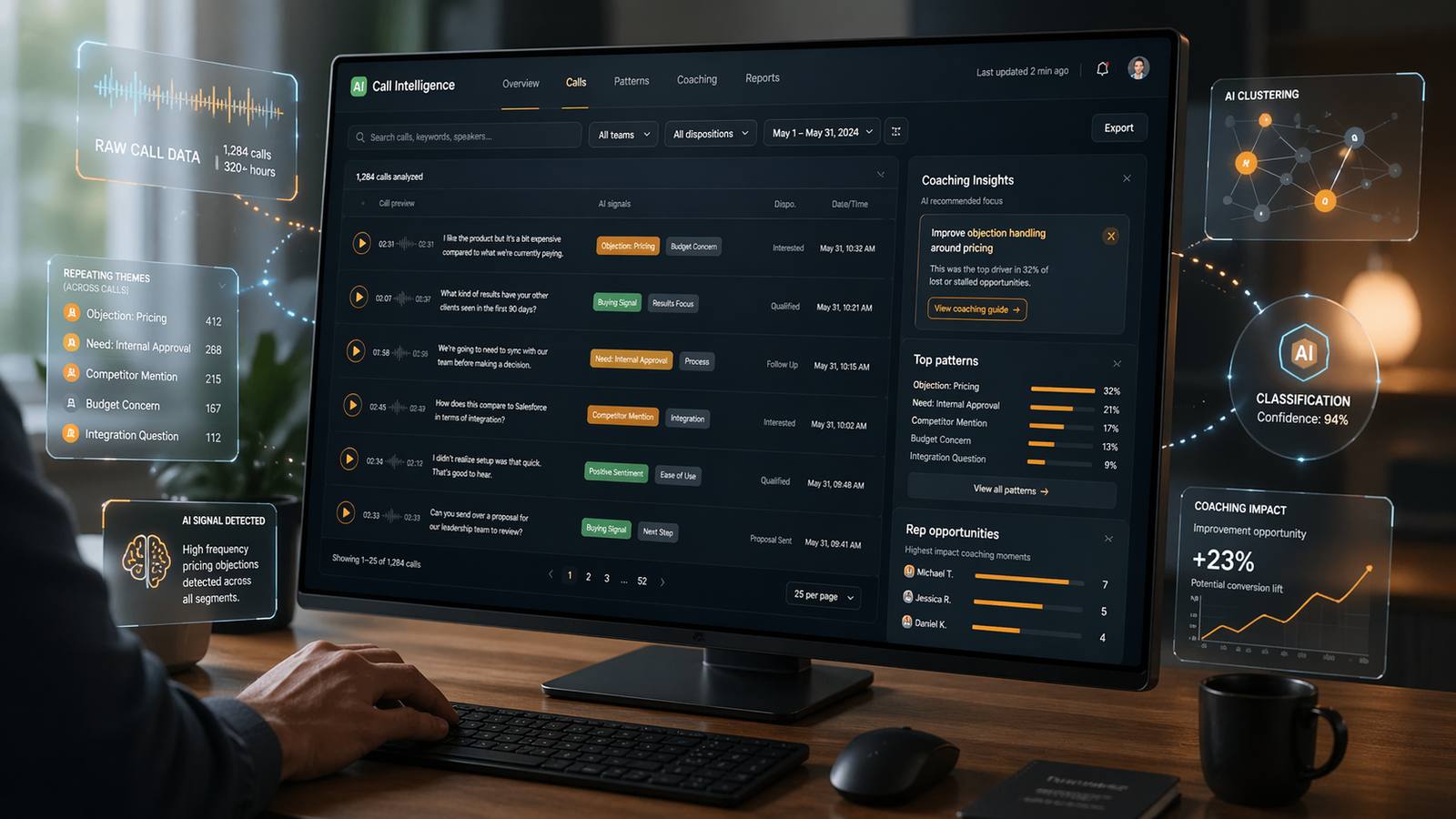
AI call intelligence is the layer that transcribes every inbound call, scores it against defined criteria, and surfaces rep-level patterns managers cannot catch through spot-checks. For high-volume B2B roles like parts counters, operators, inside sales desks, and support lines, that pattern library is where real coaching comes from. Manager intuition scales to 15 or 20 calls a day per rep. At 60 calls a day, the recordings hold the only honest record of what is actually happening on the phone.
This piece walks through the pattern that repeats across B2B high-volume inbound teams, the four gaps AI consistently surfaces that ride-alongs miss, and the four-stage framework that turns recordings into weekly coaching inputs tied to revenue analytics.
Why volume leaders rarely lead on quality
The same pattern shows up across many B2B companies that run high-volume inbound desks. A front-line operator fields 60 inbound calls a day on a parts counter, an inside sales line, or a support queue. The call log looks spotless. Volume is the highest on the floor, average talk time is the shortest, and the manager has the rep pegged as the top performer on the team.
The recordings tell a different story. When every call from a 30-day window is run through AI transcription and scoring, four distinct gaps show up across roughly 1,800 conversations per rep. None of them surfaces in quarterly ride-alongs, because a manager who sits with a rep twice a quarter only ever hears the calls the rep is already good at handling.
Four patterns AI surfaces that ride-alongs miss
Every one of these shows up in enough calls to matter. None of them gets flagged through traditional quality review.
1. Missing greeting and courtesy standards
The most basic CX standard, a consistent greeting, the customer's name used back, a polite close, is also the one most often missing. Most B2B companies have these rules written into their call scripts and onboarding decks, so leadership assumes the baseline is a solved problem. Without call-level tracking, nobody actually knows how often the standard runs. Real call libraries routinely show the full greeting and courtesy baseline performed on fewer than 50% of calls company-wide. AI flags it immediately because every call is scored against the same rubric: greeting present yes or no, customer name used yes or no, polite close present yes or no.
2. Upsell gaps
On roughly 60% of calls in a typical high-volume library there is a natural upsell or cross-sell opportunity: an add-on alongside a core order, a service plan alongside a product purchase, a related item the buyer has already signalled interest in. Reps take the upsell on under 10% of those. The playbook usually already has the template. It just goes unused on calls the rep treats as routine fulfillment.
3. IVR hang-ups
Roughly 10% of callers hang up inside the IVR menu before reaching a rep at all, with mobile hang-up rates running higher. That signal never appears in call volume reports, because the calls never get logged as calls. The AI catches it through carrier-side data and ties the hang-up pattern to specific menu prompts.
4. Routing failures
Calls that should be warm-transferred to another team get handled at the operator's desk because the rep does not want to hand them off. A share of those callers never ring back after getting a half-answer. The AI catches them because the transcripts reference keywords that belong to a different team, visible only when every call is read at once.
The framework: transcription to coaching inputs
The pattern library only works if the pipeline from raw recording to coaching prompt is structured. Four stages, each producing a specific output the next stage consumes.
Transcription
Every inbound call recorded and transcribed via an AI layer that handles accents, technical vocabulary, and 20-second hold interruptions. Accuracy above 94% on industry terms is the bar. Below that, every coaching prompt built on top of the transcripts inherits the noise.
Scoring
Every transcript scored against the same five to seven criteria the coaching program is built on. Greeting, discovery, qualification, next-step commitment, and objection handling cover most B2B inbound desks. Scoring runs nightly, not once a quarter.
Pattern flagging
Scored calls grouped by rep, by skill, and by outcome. Rep-level patterns (this one rep skips qualification on 40% of calls) matter more than absolute scores. Managers get a weekly digest of the three patterns that moved most, not a dashboard to mine.
Coaching prompts
Flagged patterns feed a one-page weekly coaching brief for each rep. Two specific calls to review, one skill to focus on, one behavior to stop. The brief is the input to the Monday one-on-one, not a replacement for it.
What changes inside 90 days
Three outputs show up consistently in the reporting layer. Inbound conversion on a high-volume operator's line typically lifts 20 to 25% against the prior-quarter baseline, with one recent implementation landing at 23%. Handoff quality improves because the routing failures get caught upstream, reducing the repeat inbound volume teams had been absorbing for months. Manager coaching hours drop by roughly a third, because Monday one-on-ones now focus on specific calls instead of general impressions. Same reps, same shifts, same volume. The recordings were there all along. The system to act on them is what changes.
How is AI call intelligence different from standard call recording?
Standard call recording stores audio. AI call intelligence transcribes, scores, and surfaces patterns across the whole call library. Beyond the words, modern scoring layers also pick up sentiment on both sides of the call: rep frustration or rush, customer hesitation or anger, tone shifts mid-conversation, extended silences, talk-to-listen ratio, and interruption frequency. The difference is that recording only lets a manager review the calls they already think are interesting. AI call intelligence surfaces the calls they did not know to look at, including the ones where nothing in the log screams bad call but sentiment and pacing tell a different story. That is where most coaching value lives in high-volume roles.
Does AI call scoring replace manager ride-alongs?
No. Ride-alongs still matter for body language, desk workflow, and rapport. What AI replaces is the assumption that a handful of sampled calls represents the rep's actual performance. The recordings become the honest baseline. The ride-along adds the context the audio cannot capture, and the two combined are stronger than either alone.
What call volume makes AI call intelligence worth implementing?
At 10 or more inbound calls per rep per day, the math works. Below that, a manager can still ride along enough calls to catch patterns manually. Above it, recordings become the only practical way to coach from real data instead of intuition. Most industrial services operators, multi-location B2B firms, inside sales teams, and support queues clear that threshold on day one.
Synapse Edge is a B2B revenue infrastructure consultancy, not a software vendor. We design and implement AI call intelligence as part of broader call tracking and CRM architecture work for B2B operators where phone calls drive the majority of pipeline.
Key takeaways
- Manager intuition scales to about 15 to 20 calls per rep per day. Above that, AI call intelligence is the only way to coach from real data instead of spot-checks.
- Expect recurring patterns in high-volume inbound roles, including missing greeting and courtesy standards (hit on under 50% of calls in most libraries), upsell gaps, IVR hang-ups, and routing failures. All of them are invisible to manager ride-alongs and surface only when every call is read at once.
- The framework is four stages: transcription, scoring, pattern flagging, and coaching prompts. Each stage produces a specific output the next stage consumes.
- Scoring should run nightly against five to seven criteria, not monthly against vibes. Rep-level patterns matter more than absolute scores.
- At 10 or more inbound calls per rep per day, the investment pays back inside 90 days. Below that, manual review is still workable.
AI call intelligence is the infrastructure that records, transcribes, and scores every inbound call, then surfaces rep-level patterns across the whole call library. For B2B operators where a single rep handles 30 to 60 inbound calls a day on a parts counter, inside sales desk, rental coordinator line, or support queue, it replaces spot-check coaching with a weekly pattern digest. The framework runs in four stages: transcription, scoring, pattern flagging, and coaching prompts. Typical outcomes inside 90 days include a 20 to 25% lift on inbound conversion, improved handoff quality on calls routed to another team, and roughly a third fewer manager coaching hours spent on general impressions instead of specific calls.
If your team clears 10 or more inbound calls per rep per day and coaching still runs on quarterly ride-alongs, a short strategy call is the fastest way to pressure-test what your call library would surface. Book 45 minutes at synapseedge.com/strategy-call.