
I've spent the better part of a decade working inside B2B commercial operations, not advising from the outside, but building and fixing the systems that determine whether leads become revenue.
The pattern I see is remarkably consistent, regardless of industry, geography, or company size.
A business that has been operating for 10 or 20 years. A real product with real customers. A sales team that works hard. Marketing spend that has been steadily increasing. And yet, pipeline feels unpredictable. Conversion rates are flat. Leadership can't point to exactly where the growth is getting blocked.
The default response is usually to add more: more budget, more leads, more headcount, more tools. The actual problem is almost never more. It is a structural gap between the parts of the commercial system that are supposed to work together, and don't.
What is a revenue infrastructure gap?
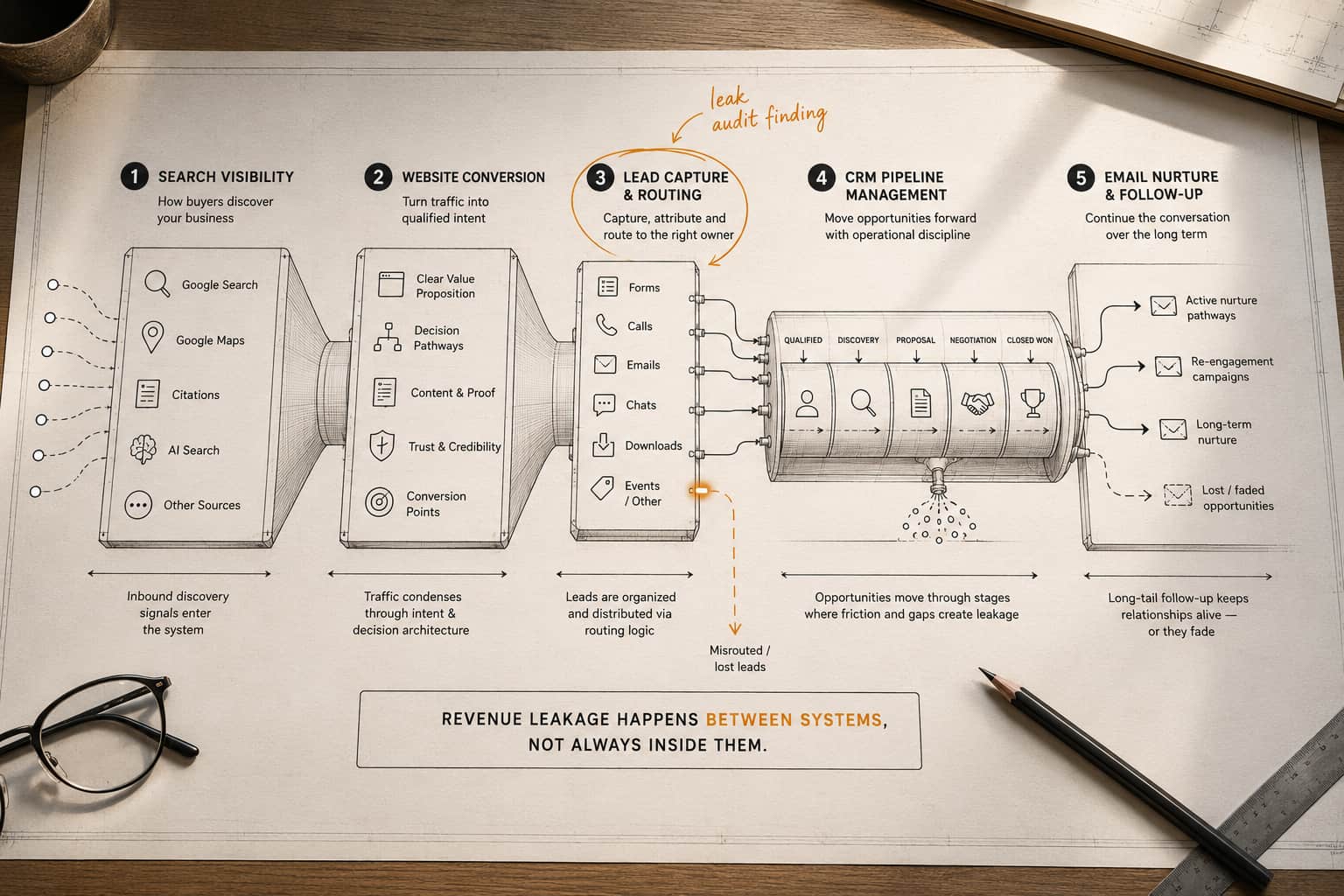
When I talk about revenue infrastructure, I mean the connected system of components that turns market demand into closed revenue:
- Your digital visibility: how buyers find you through search, both traditional and AI-powered
- Your website: whether it converts that visibility into qualified intent
- Your lead capture system: whether leads from all channels (including phone calls) are tracked and attributed
- Your CRM structure: whether leads are routed correctly, staged accurately, and progressed systematically
- Your follow-up execution: whether every lead receives a consistent, timely response
- Your reporting layer: whether leadership can actually see what is working and what is not
A gap is wherever one of these components is broken, missing, or disconnected from the others.
Here is the uncomfortable reality: most established B2B companies have at least three of these gaps operating simultaneously. They are rarely dramatic failures, not a single catastrophic problem. They are quiet, persistent leaks that drain revenue slowly enough that nobody declares an emergency.
From the field: At one of Europe's largest Cat® equipment dealer groups, lead-to-sale conversion was sitting at 0.24% in 2017. Not because the product was wrong or the market was weak, but because inbound leads had no routing system, no CRM discipline, no follow-up sequences, and no way for management to see the problem. The same sales team, three years later, with the infrastructure rebuilt, was converting at 2.3%. Same team. Same market. Different system.
Why established companies have more gaps than startups
This surprises people. You would expect that a company with a decade of experience and a working revenue base would have cleaner infrastructure than a startup. The opposite is usually true, for three reasons.
1. Systems were built incrementally, not architecturally
Early-stage companies build what they need to close the next deal. A CRM gets set up, but stages are never properly defined. Call tracking gets installed, but data never flows into the CRM. Email sequences get created, but they are never connected to lead scoring. Over years, these half-implementations accumulate into a system that technically exists but does not actually work as a system.
2. Process lives in people, not documentation
In mature companies, a significant amount of commercial process is held in the heads of long-tenured employees. The senior sales rep who knows which leads to prioritize. The marketing manager who remembers how the attribution model was set up. The ops person who manually cleans the CRM every week before the Monday pipeline review.
This works until it doesn't. When people leave, the process leaves with them. What looks like a functioning operation is often a collection of individual workarounds held together by institutional memory.
3. Growth pressure prevents infrastructure investment
There is always a reason to defer infrastructure work. A major deal in the pipeline. A new territory launching. A product expansion. These are legitimate priorities, but they mean the structural layer never gets addressed. The company grows around the gaps rather than through them.
The five infrastructure gaps I find in almost every B2B audit
After running structured commercial audits across construction, equipment, real estate, and industrial sectors, these five gaps appear with remarkable consistency.
Gap 1: Phone calls are not tracked as leads
In high-ticket B2B (equipment sales, fleet rental, industrial services, real estate), the phone call is often the highest-value conversion action on the website. A prospect who calls is significantly more likely to buy than one who fills out a form.
And yet, in the majority of companies I audit, phone calls are not tracked back to the channel that generated them. The CRM records a call. It does not record whether that call came from a Google Ad, an organic search, a Google Business Profile listing, or a referral. The marketing team is optimizing blind.
In one construction equipment engagement, call tracking revealed that 40% of the highest-quality leads were coming from a channel that was receiving none of the marketing budget, because forms (which were being tracked) were pointing to a different source entirely.
Gap 2: The CRM is a record, not a system
Most CRM implementations in established companies share the same fundamental problem: the system was set up to record what happened, not to drive what happens next.
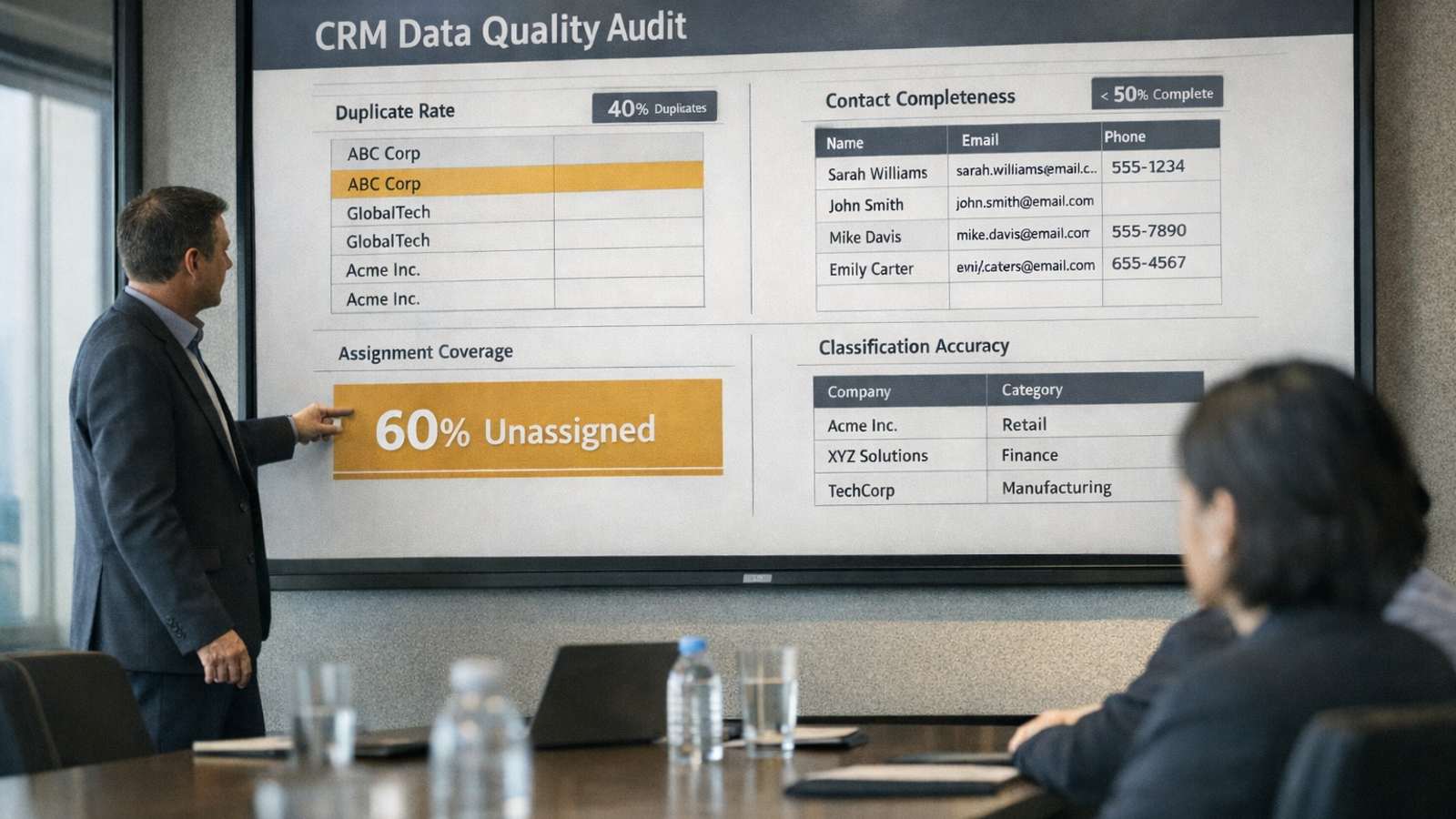
Stages are labels, not process controls. There are no exit criteria, no defined conditions a deal must meet before moving to the next stage. Reps move deals based on intuition. Managers run pipeline reviews on data that has not been cleaned since the last review. Loss reasons are free text fields that produce meaningless data.
The consequence is invisible: leadership cannot see where deals are actually stalling. They see a pipeline number. They do not see that 60% of the deals in 'Proposal' have had no activity for 45 days.
Gap 3: Follow-up is discipline-dependent, not system-dependent
The most common cause of B2B revenue loss I encounter is leads that were never followed up, not because the team was negligent, but because there was no system to ensure follow-up happened.
The research on lead response time is unambiguous: contacting a lead within five minutes of inquiry increases the probability of contact by 10x compared to contacting them after 30 minutes. Most B2B companies have average response times measured in hours, sometimes days.
The fix is not motivating the sales team harder. It is building the system: automated immediate response on lead creation, escalation alerts when SLAs are breached, structured follow-up sequences that persist regardless of rep behavior. When the system follows up, conversion rates improve predictably. When follow-up depends on discipline, results vary with discipline.
Gap 4: Digital visibility is optimized for traffic, not for commercial intent
Most B2B companies with an SEO program optimize for traffic volume. They publish content, they track rankings, they celebrate when organic sessions increase.
The metric that actually matters is commercial-intent traffic: visitors who are in a buying process, not a research process. In equipment, fleet, and industrial categories, commercial-intent traffic might represent 15–20% of total organic traffic, but 80%+ of lead volume from that channel.
In 2026, this problem has an additional dimension: AI search. When a procurement manager asks ChatGPT or Perplexity who to contact for heavy equipment rental in their region, the answer is determined by which companies have built structured authority signals, not by who is ranking #1 on Google. The companies showing up in AI answers are already building a brand preference advantage that will compound over the next three to five years. Most of their competitors have not noticed yet.
Gap 5: There is no single owner of the full system
Marketing owns the website and the leads. Sales owns the pipeline and the close. Operations owns delivery. IT owns the CRM infrastructure. Finance owns the reporting. Nobody owns the connection between these parts.
This is the meta-gap that allows all the others to persist. When a lead falls through between marketing and sales, both teams believe the other one was responsible. When CRM data is unreliable, sales and marketing produce separate numbers and neither can be trusted. When AI visibility is declining, nobody has been assigned to notice.
What closing these gaps actually looks like
In a typical B2B engagement, the first phase is always diagnostic: a structured audit of every layer. We look at analytics data, call tracking records, CRM pipeline data, follow-up logs, and organic visibility. We are building a precise picture of where revenue is escaping and in what volume.
The output of that audit is a prioritized action list. Not a 60-page strategy document, but a backlog of specific interventions, ordered by revenue impact per implementation cost.
Typical early wins, within the first 60–90 days:
- Call tracking implemented, revealing true channel attribution for the first time
- CRM stages redefined with documented exit criteria, giving management a trustworthy pipeline view
- Automated immediate lead response set up, dropping average response time from hours to minutes
- Commercial-intent pages rewritten with answer-first structure, improving both conversion and AI visibility
- Weekly pipeline report automated, eliminating the Monday morning cleanup that was taking two hours of someone's time
None of these require budget increases. They require structural changes to existing systems.
The compounding effects come over six to eighteen months: as CRM data becomes reliable, forecasting improves. As follow-up becomes systematic, conversion rates stabilize. As digital visibility shifts toward commercial intent, cost per qualified lead decreases. As AI visibility builds, brand preference accumulates independently of paid spend.
Key takeaways
- B2B revenue gaps are almost always structural, not motivational. More budget applied to a broken system produces incremental results at best.
- The five most common gaps: untracked phone calls, CRM as record-keeping not system, follow-up that depends on individual discipline, SEO optimized for traffic not commercial intent, and no single owner of the end-to-end system.
- Established companies often have more infrastructure debt than startups because systems were built incrementally and process lives in people rather than documentation.
- In 2026, AI search is an emerging gap: companies without structured authority signals are building a brand invisibility problem that will compound over the next 3–5 years.
- The diagnostic comes before the fix. The most valuable thing any B2B company can do is get a precise picture of where revenue is escaping, before committing to any particular solution.