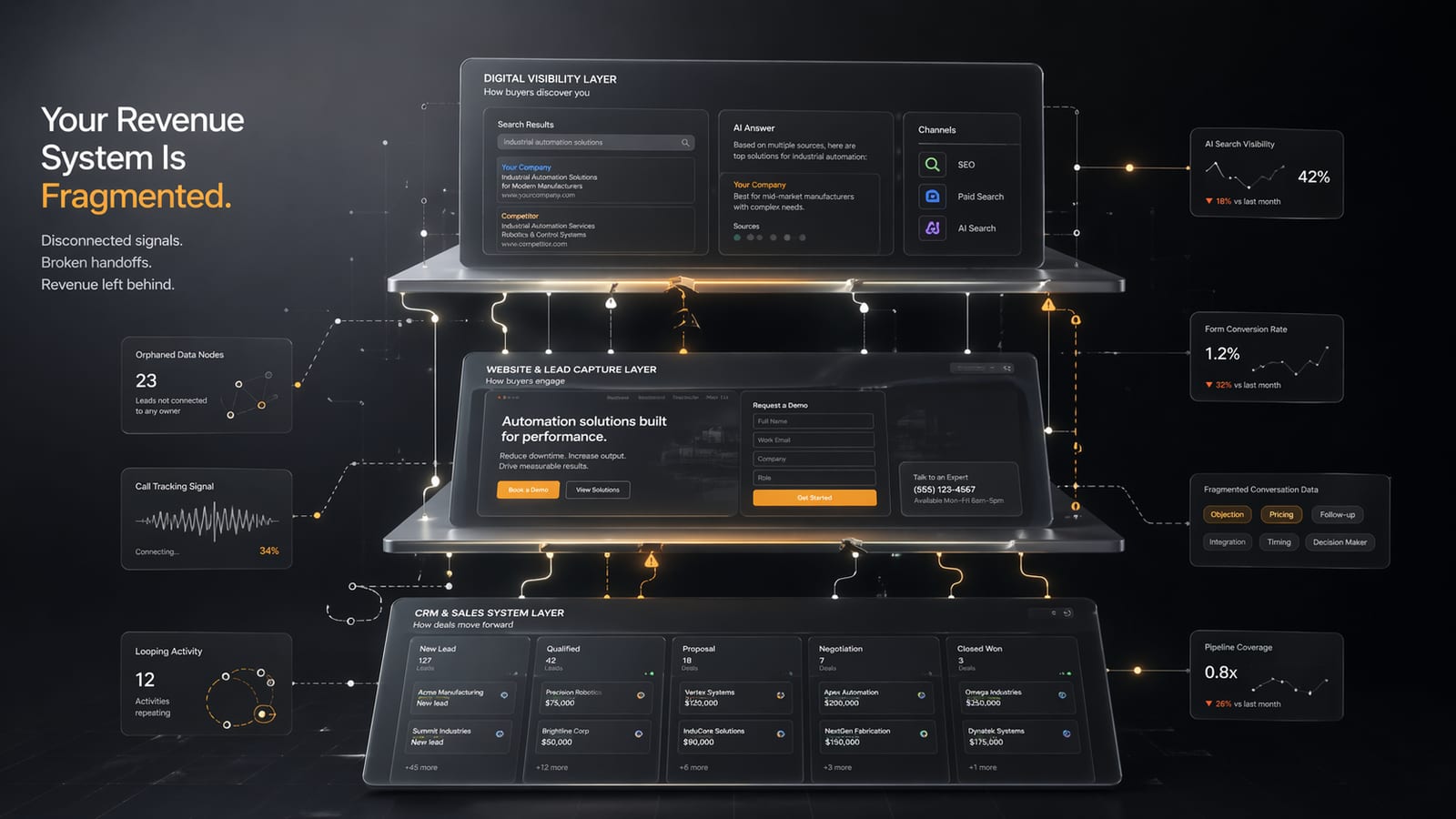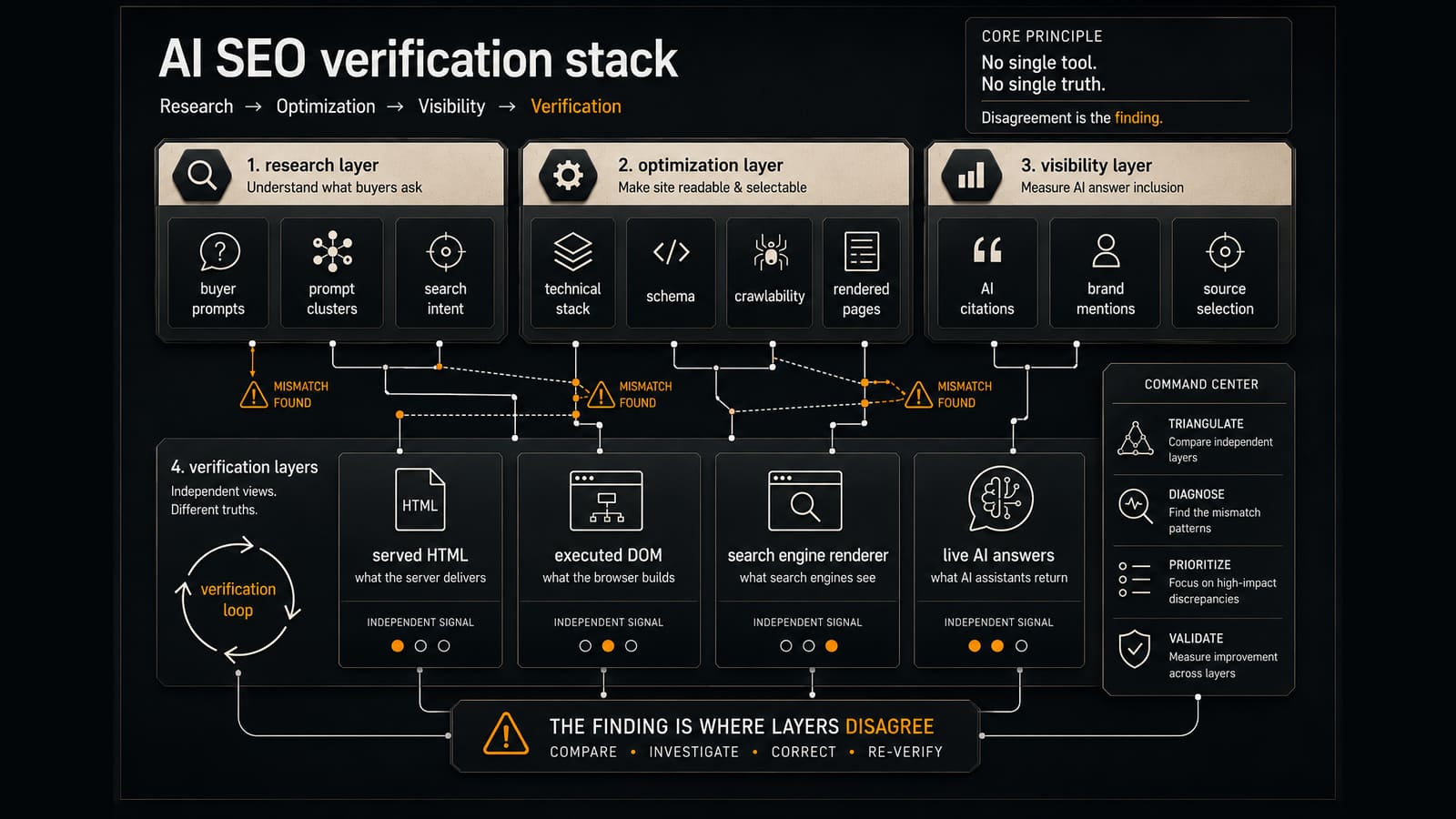
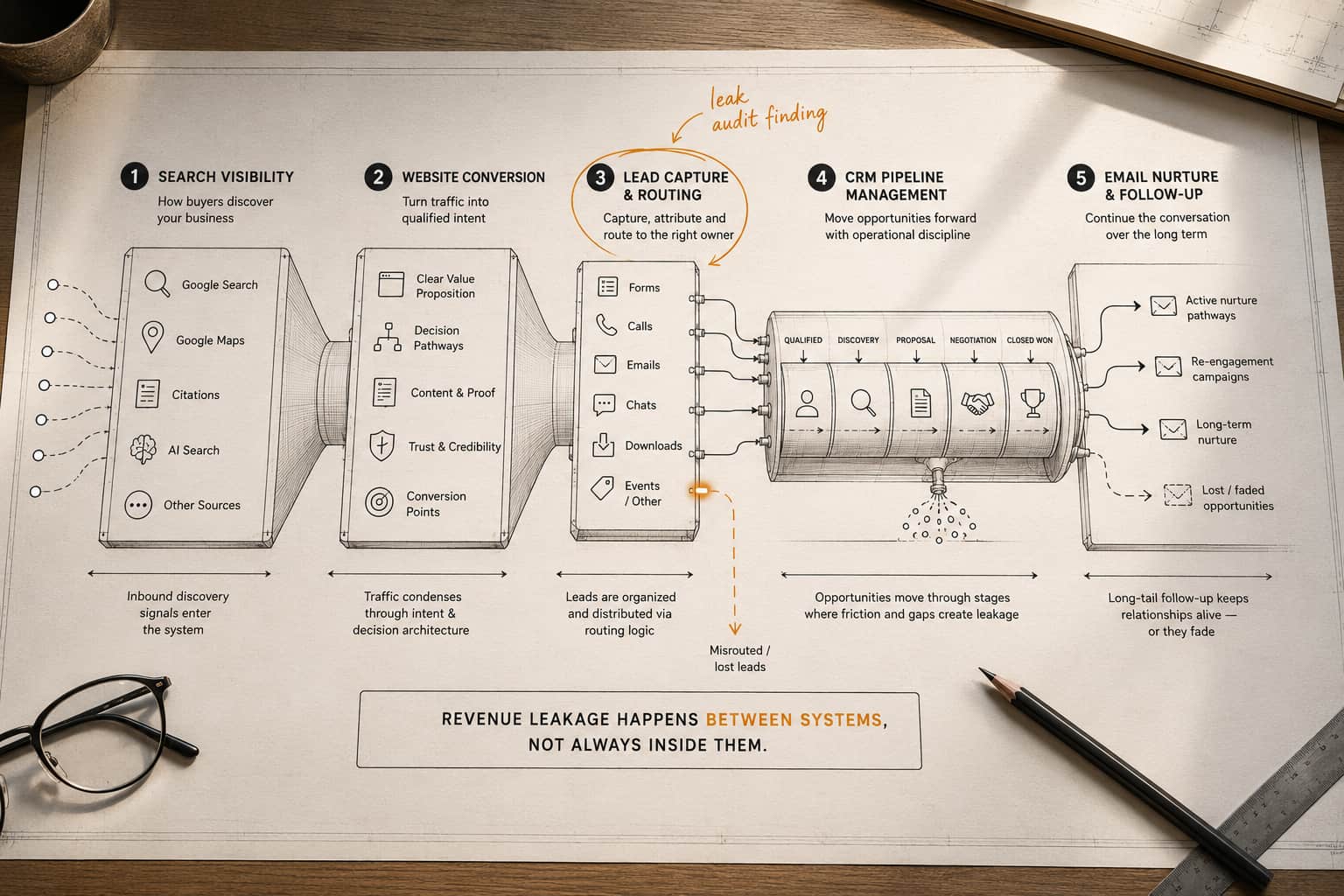
A full-stack B2B revenue audit examines five operational layers: SEO and GEO visibility, website conversion, lead capture and routing, CRM pipeline hygiene, and email nurture. The point of the audit is to identify where revenue is being lost across the commercial system and in what order to fix it. Most audits look at one or two layers and miss the structural gaps between them, which is where most revenue actually leaks in established B2B operations.
Why do most B2B revenue audits miss the point?
Most audits are scoped narrowly because most consultancies sell a single discipline. A digital agency audits the website and reports back on CRO scores. A CRM consultant audits Salesforce or HubSpot and reports back on data hygiene. An SEO firm audits keywords and rankings.
Each report is technically correct. None of them tell the operator where revenue is actually leaking, because revenue leaks across handoffs, not inside silos.
6sense's 2025 B2B Marketing Metrics Research found that 80% of B2B organizations have an ABM program in place, but only 29% measure with ABM-aligned metrics. The same report flagged that 84% of buyers pick a favored vendor before talking to sales. Both numbers point at the same gap: the strategy exists, the execution exists in pockets, but the connections between strategy, execution, and measurement are missing.
A full-stack revenue audit is built on the assumption that no single discipline can find the leak alone. The audit covers every layer in sequence, then maps the connections between them.
- Single-discipline audit: tells you the score within one system
- Full-stack audit: tells you which handoff is dropping revenue and which fix unlocks others
What are the five layers of a full-stack revenue audit?
The five layers are sequenced deliberately, from top-of-funnel discovery to closed-won revenue. Each layer is a complete audit on its own. The integration between layers is where structural gaps appear.
- SEO and GEO visibility: how buyers find the business across Google and AI search
- Website conversion: how the website turns visibility into qualified intent
- Lead capture and routing: how inbound leads from every channel are tracked, attributed, and assigned
- CRM pipeline hygiene: how leads progress through stages and what data lives at each one
- Email nurture and follow-up: what happens to leads that do not close in the first 30 days
The full audit checks every layer, then traces lead flow across the connections. The findings from each layer feed into a single prioritized roadmap, not five separate reports.
How do you audit SEO and GEO visibility?
This layer checks whether the business is findable in both traditional Google search and AI search engines. The questions are different at each surface, and the audit covers both.
For Google, the audit reviews technical SEO (crawlability, indexation, schema, Core Web Vitals), content depth on commercial-intent pages, multi-location local SEO if relevant, and the off-site authority profile. For AI search (ChatGPT, Perplexity, Gemini, Google AI Overviews), the audit tests whether the brand appears in answers to high-intent queries, what content gets cited, and whether the site is configured to allow AI crawlers in the first place.
- Robots.txt blocks GPTBot, ClaudeBot, or PerplexityBot entirely
- Commercial-intent pages have no structured data
- LLM queries return competitors but not the audited brand
- The site ranks for branded queries but is invisible for solution queries
- No author bios, no schema for E-E-A-T signals
How do you audit website conversion?
This layer checks whether traffic turns into qualified inquiries. The unit of analysis is the page, not the channel.
The audit reviews the conversion path on the homepage, services pages, and high-intent landing pages. Specifically: is there one primary CTA per page, does it match the page intent, is the form short enough to complete, is there proof (case study, testimonial, specific number) above the fold, and does the page answer the buyer's question within five seconds of arrival.
- Multiple competing CTAs on a single page
- Forms that ask for fields the sales team never uses
- Case studies that read like brochures, not evidence
- No clear path from "interested" to "qualified lead"
- Pages optimized for SEO ranking that fail at conversion
How do you audit lead capture and routing?
This layer checks every channel through which a lead can enter the business: web forms, phone calls, chat, direct email, partner referrals, walk-ins, and trade shows. The audit traces what happens to each lead from first touch to assignment.
In high-ticket B2B, the phone call is often the highest-value conversion. The audit specifically asks whether phone calls are tracked back to the channel that generated them (a Google Ad, an organic search, a Google Business Profile listing, a referral), and whether the call lands in the CRM with the right attribution. Without call tracking, the marketing team is optimizing blind.
- Phone calls are not tracked as marketing-attributable leads
- Web forms route to a shared inbox rather than the CRM
- Trade show contacts never make it into the CRM at all
- Round-robin routing assigns leads regardless of territory or expertise
- Response times exceed 24 hours on at least one channel
How do you audit CRM pipeline hygiene?
This layer checks whether the CRM is a sales support system or a storage tool. The difference is whether the data actually helps reps work better and gives leadership a reliable view of pipeline.
The audit reviews stage definitions (are they consistent across the team), data quality (assignment, duplicates, required fields), reporting (can leadership see what is converting and what is not), and process integration (does the CRM connect to lead sources, the calendar, and the sales engagement layer).
- 40 to 60 percent of leads are unassigned or assigned to inactive users
- Stage definitions vary by rep, so reports do not compare across the team
- Required fields exist on the form but are bypassed on record creation
- Pipeline reviews run on data that was manually cleaned the morning of the meeting
- No systematic way to identify cold leads or stalled deals
How do you audit email nurture and follow-up?
This layer checks what happens to leads that do not close in the first 30 days. In long-cycle B2B (3 to 9 months from first touch to close), nurture is where 50 to 70 percent of revenue actually comes from.
The audit reviews whether triggered sequences exist for cold leads, whether segmentation is meaningful (by stage, by source, by industry), whether educational content is delivered on a real cadence, and whether engagement gets fed back into the lead scoring and CRM stage.
- No automated nurture sequences. Long-cycle leads go cold by default.
- Nurture exists but is broadcast, not segmented
- Behavioral triggers (page visits, email opens) do not update CRM stages
- Content sent in nurture is promotional, not educational
- Sales reps are never told when a nurtured lead re-engages
What does a real audit finding look like?
The pattern I have seen across multiple commercial audits at European and North American equipment dealer groups is remarkably consistent. A business with a working product, a real customer base, and a sales team that puts the hours in. Pipeline that feels unpredictable. Conversion rates that are flat. Leadership that cannot point to exactly where the growth is getting blocked.
At one of those engagements, lead-to-sale conversion was sitting at 0.24 percent. The product was right. The market was healthy. The sales team worked hard. The reason for the number was structural: inbound leads had no routing system, no CRM discipline, no follow-up sequences, and no way for management to see the problem. Three years later, with the infrastructure rebuilt, the same team was converting at 2.3 percent.
The audit did not change the product. It did not change the market. It did not even change the team. It changed the structure that connected lead capture to closed-won revenue, which is where the leak had been hiding the whole time.
This is what a structural finding looks like. The individual systems all worked in isolation. The integration between them was broken, and the broken integration was invisible to any single-discipline audit. The CRM had data in it. The website had traffic. The marketing team was hitting MQL targets. And revenue was still leaking, because nothing was tracing the flow from end to end.
What order should you fix the leaks in?
Not all leaks are equal. The audit produces a prioritized roadmap, not a comprehensive to-do list. Two criteria drive the order:
- Revenue recovery potential: how much pipeline is being lost at this layer right now
- Effort and dependency: which fixes unlock other fixes downstream
Lead capture and routing usually comes first. Until every lead is tracked and assigned, every other layer is optimizing on partial data. A clean CRM cannot fix leads that never reach it. Nurture sequences cannot warm leads the system never received.
CRM pipeline hygiene typically comes second, for the same reason. The reporting layer cannot be trusted until the data layer is trustworthy.
SEO and GEO visibility and website conversion are scheduled around the operational fixes. Driving more traffic to a broken funnel just amplifies the leak. The audit usually recommends a 60-day operational sprint first, then a 90-day visibility and conversion sprint.
Email nurture sits across the timeline because it is built incrementally. Triggered sequences for the highest-volume sources go first. Segmentation and behavioral triggers come once the CRM is clean enough to feed them. This sequencing principle is part of the broader revenue architecture framework we use across every engagement.
How long does a full-stack audit take?
A full-stack audit at a mid-market B2B operation typically takes two to three weeks of focused work, plus access to the systems being audited.
- Week 1: data collection and stakeholder interviews. Read access to GA4, Google Search Console, the CRM, the email platform, the calling system, and the website backend. Interviews with sales leadership, marketing leadership, and at least two front-line reps.
- Weeks 2 to 3: analysis and prioritized roadmap. Each layer is audited independently, then connections between layers are traced. Findings are documented with evidence, screenshots, and specific examples. Output is a prioritized roadmap: what to fix, in what order, who owns each item, and what the expected revenue recovery looks like over the next 90 days.
Most B2B operations come out of the audit with 15 to 25 specific findings. The top five usually account for 60 to 80 percent of the revenue recovery potential. The rest of the roadmap is a 90- to 180-day plan that touches every layer at least once.
Key takeaways
- Revenue leaks happen across handoffs between disciplines, not inside any single discipline. Single-discipline audits cannot find them.
- A full-stack audit covers SEO and GEO visibility, website conversion, lead capture and routing, CRM pipeline hygiene, and email nurture as one connected system.
- The audit produces a prioritized roadmap, not a comprehensive to-do list. The top five findings typically carry 60 to 80 percent of the revenue recovery.
- Lead capture and routing usually takes priority because every downstream layer depends on it.
- A mid-market audit takes two to three weeks of focused work. Most operations identify 20 to 40 percent revenue recovery potential within the first 90 days of implementation.
A full-stack B2B revenue audit diagnoses where pipeline is leaking across five operational layers: SEO and GEO search visibility, website conversion, lead capture and routing across all channels including phone calls, CRM pipeline hygiene and stage discipline, and email nurture for long-cycle leads. The audit checks each layer independently and then traces lead flow across the handoffs between them, which is where most revenue actually leaks in established B2B operations. A mid-market audit takes two to three weeks of focused work and typically identifies 20 to 40 percent revenue recovery potential within 90 days. Common findings include untracked phone-call leads, CRM stages defined inconsistently across reps, absent automated nurture sequences for long-cycle leads, AI search invisibility, and website pages that rank but fail to convert. The audit produces a prioritized roadmap rather than a comprehensive to-do list, with the top five findings typically accounting for the bulk of revenue recovery potential.
If you operate a B2B revenue function and want a structured read on where your own pipeline is leaking before adding more marketing spend, book a 45-minute strategy call at synapseedge.com/strategy-call. The call walks through the five-layer framework against your current setup and identifies the top three leaks you should address first.