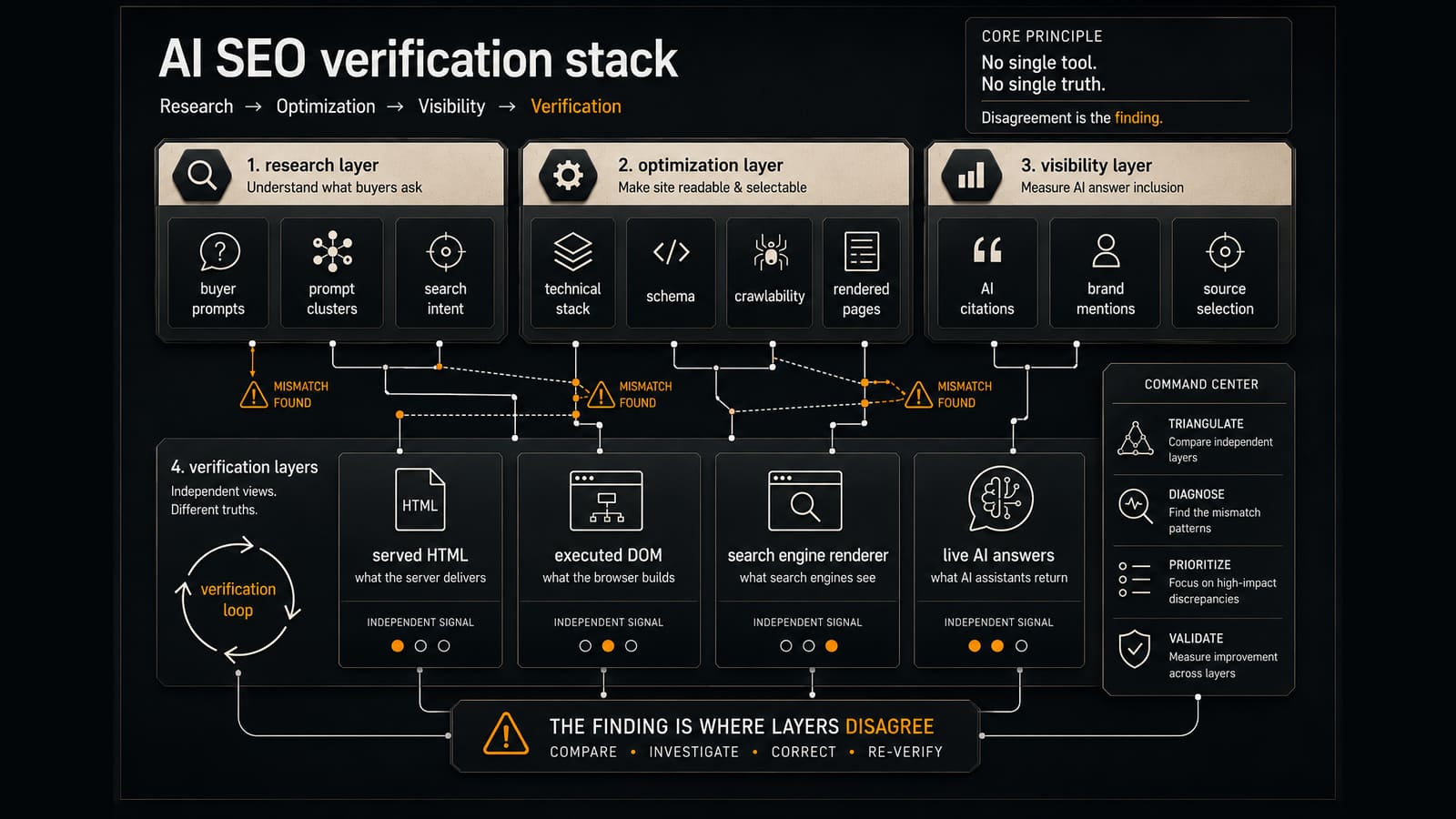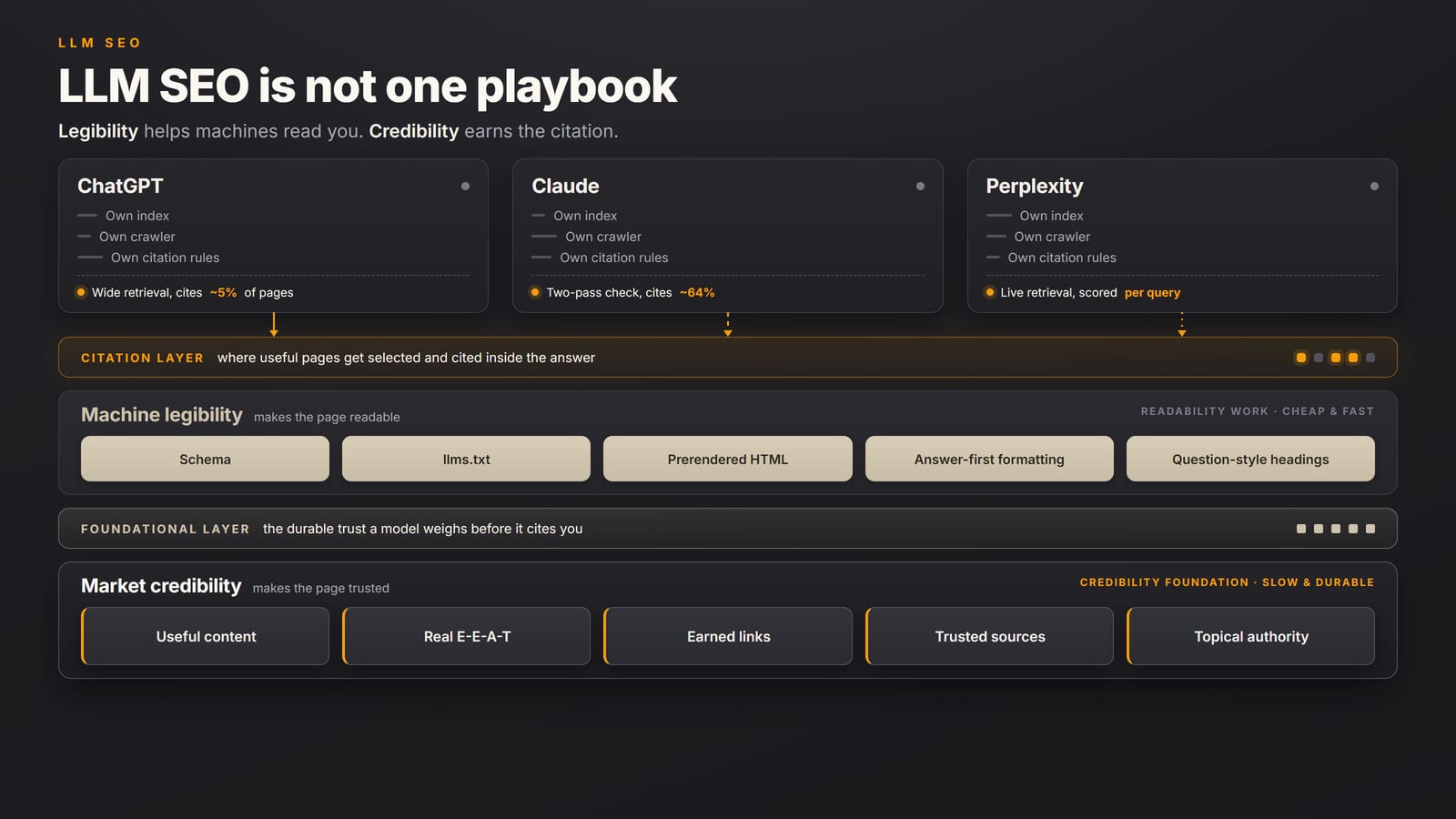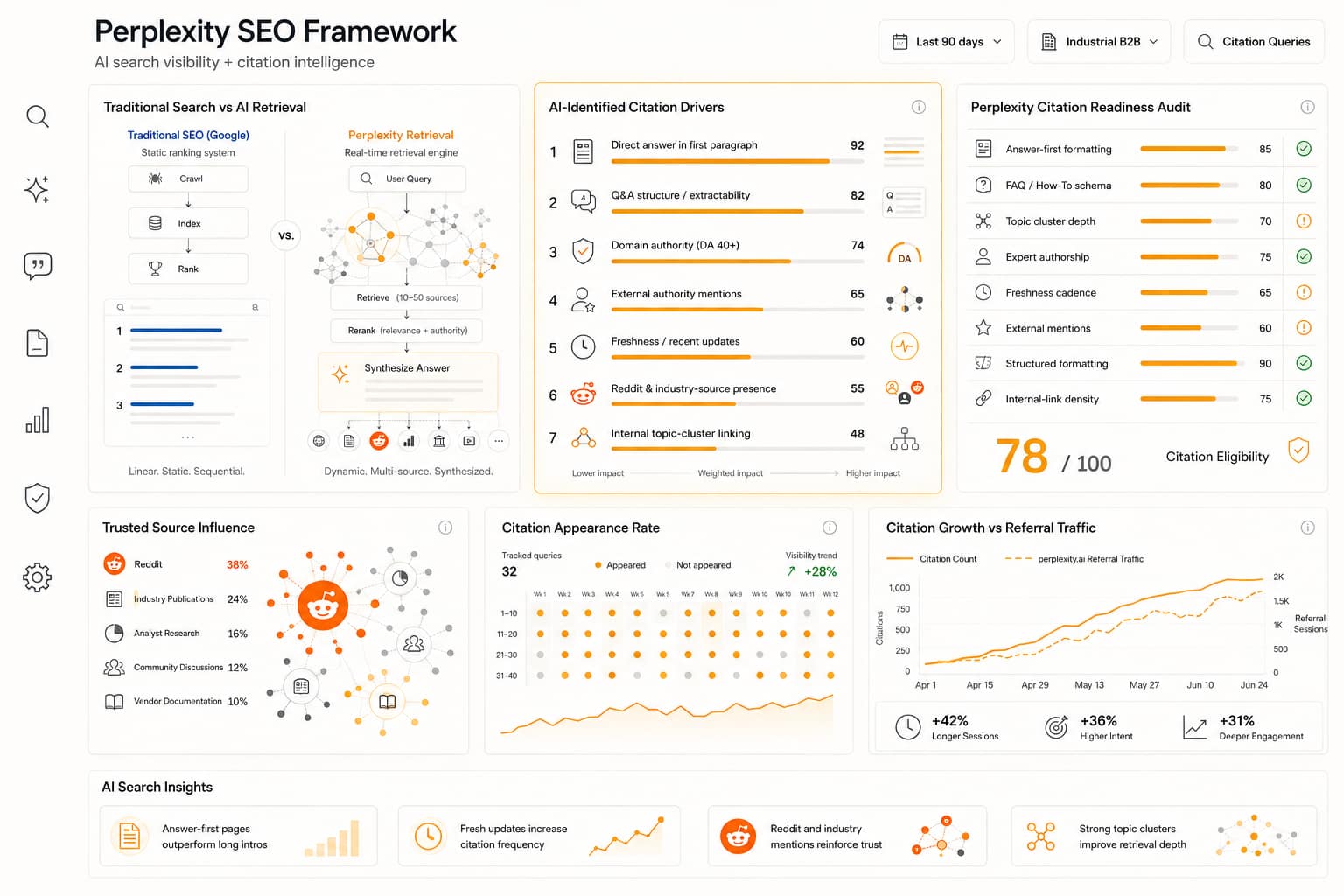

GEO, AEO, AIO, and SEO are four distinct optimization disciplines targeting four different systems. Treating them as synonyms is the reason most B2B companies rank on Google but remain invisible inside AI-generated answers.
The confusion is understandable. All four involve content and search. But the output metric, the platform, and the underlying mechanism are completely different. The new rules of B2B search visibility covered the three-layer framework; this post adds the fourth layer and the most common place B2B companies are leaking visibility without knowing it.
The four layers, defined
SEO: search engine optimization
SEO is the discipline of getting your pages to rank in Google and Bing. The output metric is clicks. It operates through crawling, indexing, backlink authority, and on-page relevance signals. Without solid SEO, the other three layers have no foundation to build on.
AEO: answer engine optimization
AEO targets Google's zero-click features: featured snippets, People Also Ask boxes, and position-zero answers. The output metric is placement, not clicks. A page that wins position zero often receives fewer clicks than a page ranked third, because the user gets the answer without visiting the site.
AEO content is structured for extraction: short, declarative, formatted as a direct response to a specific question. If your content buries the answer in paragraph three, it does not qualify.
GEO: generative engine optimization
GEO is what happens when ChatGPT, Perplexity, Gemini, or Google AI Mode synthesizes a response. The output metric is citation: whether your brand or content is referenced inside the AI-generated answer. There are no guaranteed clicks. The traffic model is completely different.
GEO is determined by three signals:
- Authority: backlinks from credible sources, brand mentions in industry publications, consistent presence across directories
- Clarity: answer-first content that opens with a direct response to the question being asked
- Freshness: recently updated content with a named author attached
AIO: AI optimization
AIO is the broadest layer. It covers how your entire digital presence is understood and interpreted by AI systems: not just whether you get cited, but how you get framed. Is your category correct? Are the competitors AI associates you with accurate? Is your positioning consistent across every surface an LLM can access?
Where GEO is about citation, AIO is about interpretation. You can appear in a response and still lose the recommendation if the framing is wrong.
The B2B visibility problem nobody audits
Here is the gap pattern I see consistently across B2B companies:
- SEO: present, often reasonably strong
- AEO: partial. Some FAQ content exists, but not formatted for extraction
- GEO: thin. Content exists but does not open with direct answers; older posts have no named authors
- AIO: almost always nonexistent
That last one is where the real damage happens.
When I queried major AI platforms about Synapse Edge this week, every model placed us in the same competitive set as HubSpot, Salesforce, and Gong. Not as a partner to those tools. As a direct alternative.
We are a consulting firm. A services business. We advise and implement. We are not a CRM platform.
The cause was not thin content. Our site uses phrases like "CRM optimization" and "sales operations" without ever spelling out that these are advisory services, not software products. The language was precise enough for a human who already understands the market, but not specific enough for an LLM to distinguish a services firm from the platforms that operate in the same space. When the models absorbed that content, they applied the most common inference available: CRM plus sales operations equals software vendor.
We are working through the fix now. The playbook is straightforward: content that defines what we are, what we are not, and who we actually compete with, applied at the top of every page and post where those terms appear, repeated consistently across every surface AI can access.
Three diagnostic questions to run before any formal audit
Before commissioning a technical audit, run these three checks:
- What does ChatGPT say when asked to describe your company? Pull the exact response. Compare it to how you describe yourself on your homepage. Note every difference in category, competitors, and audience framing.
- Who does Perplexity list as your competitors? If you are a services firm and it lists software platforms, you have a category drift problem.
- Does your homepage's first paragraph directly answer what you do and who you serve? If the first sentence is "We help companies..." or "Company X provides a range of solutions...", you are invisible to AI extraction.
These three questions give you a working baseline. For the full monitoring framework, our guide on measuring and improving AI citation visibility covers the tooling and monthly audit system in detail.
Key takeaways
- SEO, AEO, GEO, and AIO are four distinct disciplines. Winning in one does not guarantee visibility in the others.
- GEO is about citation. AIO is about interpretation of your entire brand presence across every surface AI can access.
- The most common AIO failure in B2B is category drift: being placed in the wrong competitive set because your content describes what you do without making clear what kind of company does it.
- The fix is not more content. It is more specific content: language that makes your category, your business model, and your competitive position explicit enough that an LLM can classify you correctly.
- Start with the three diagnostic questions before spending anything on a formal audit.
The bottom line
GEO, AEO, AIO, and SEO are four distinct optimization disciplines with different output metrics and target platforms. SEO produces rankings and clicks. AEO produces placement in Google zero-click features. GEO produces citations inside AI-generated responses from ChatGPT, Perplexity, and Gemini. AIO covers how AI systems interpret and categorize your entire digital presence, including whether your competitive positioning and category are accurate. For B2B companies, the highest-leverage gap is typically AIO: most have invested in SEO, experimented with AEO-style FAQ content, and recently started optimizing for GEO, but few have audited how AI models actually describe and frame their business. AI search visibility is part of the revenue infrastructure that connects your brand to buyers before they ever visit your website.
Not sure where you stand across these four layers? The AI Visibility Audit benchmarks your brand across all five AI visibility pillars in 8 minutes. Free. No login required.