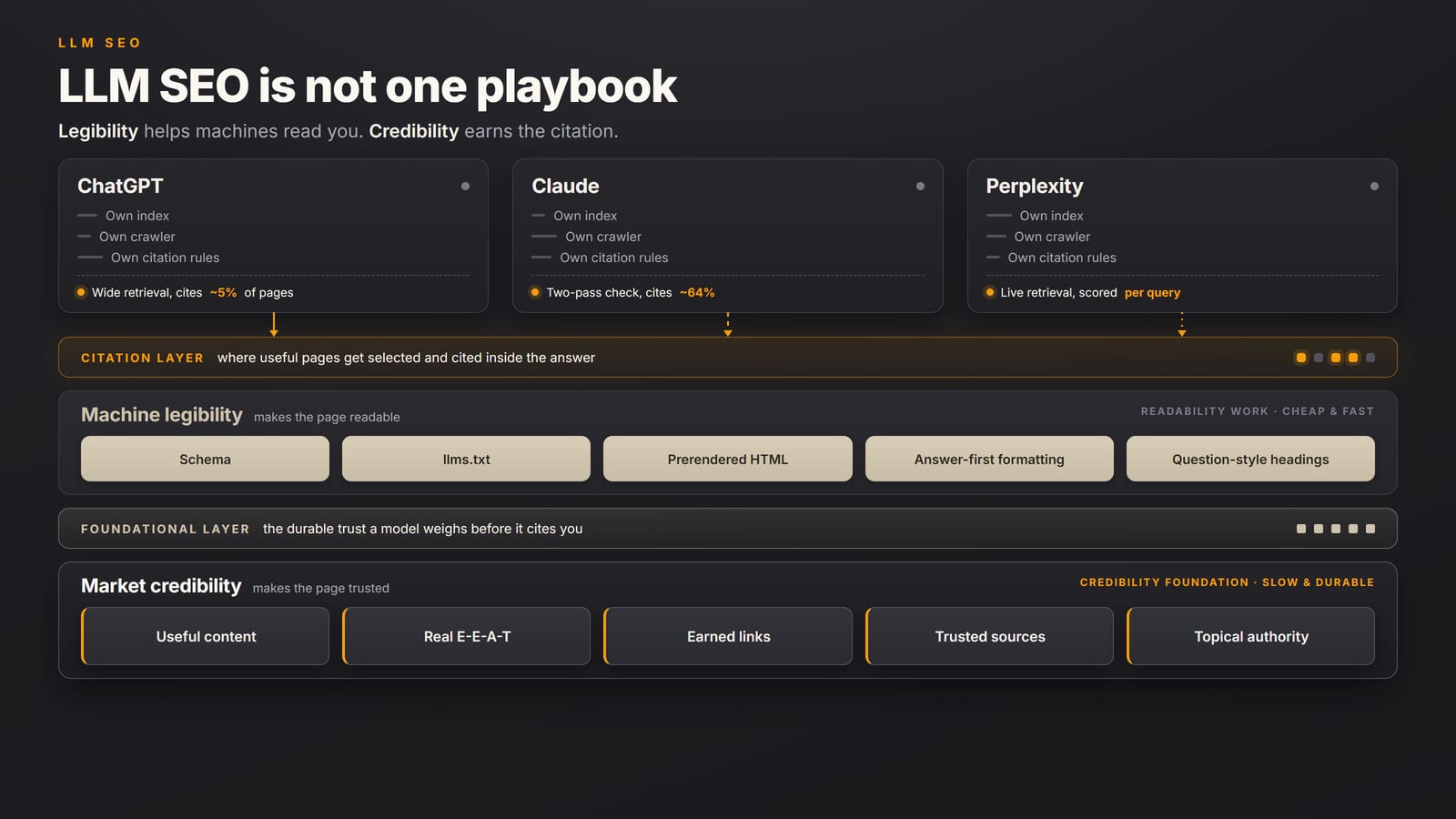
Perplexity SEO in 2026 is not about ranking. It is about getting cited as a source inside an AI-generated answer. The mechanics are different from Google: Perplexity retrieves real-time web content via its own crawler plus partner indices, scores it against the user's query, and selects 3-8 sources to cite directly in the answer it returns. Operators who consistently rank on Perplexity do five things: lead with the direct answer in paragraph one, structure content for question-and-answer extraction, hold a credible domain-authority signal, refresh content on a rapid cadence, and show up in the off-platform sources Perplexity trusts (Reddit, industry publications, primary research).
For B2B operators, this matters now because 52 percent of B2B buyers use Perplexity for vendor research and competitive comparisons (LeadWalnut 2026 buyer behavior report). Queries like "best CRM for small business" and "Salesforce vs HubSpot 2026" produce direct product citations, and companies that appear there shape buying decisions before a sales conversation ever happens. This post walks through what each layer of Perplexity SEO means in operator terms.
A note on method: since June 2026 our own monthly AI visibility checks run on ChatGPT and Google's AI features, and Perplexity is not in that prompt set. The guidance here comes from Perplexity's own documentation and the published analyses listed under Sources, not from our own Perplexity tracking.
How is Perplexity SEO different from Google SEO?
Perplexity SEO optimizes for citation inside an AI-generated answer; Google SEO optimizes for position in a list of links. Three structural differences shape every tactical decision that follows.
- Citation, not position. Perplexity cites 3-8 sources inside one synthesized answer. Google ranks 10 results per page. A Perplexity citation can drive higher-intent traffic than position one on Google for the same query, because the user who clicks the citation is choosing to read more, not landing on a list.
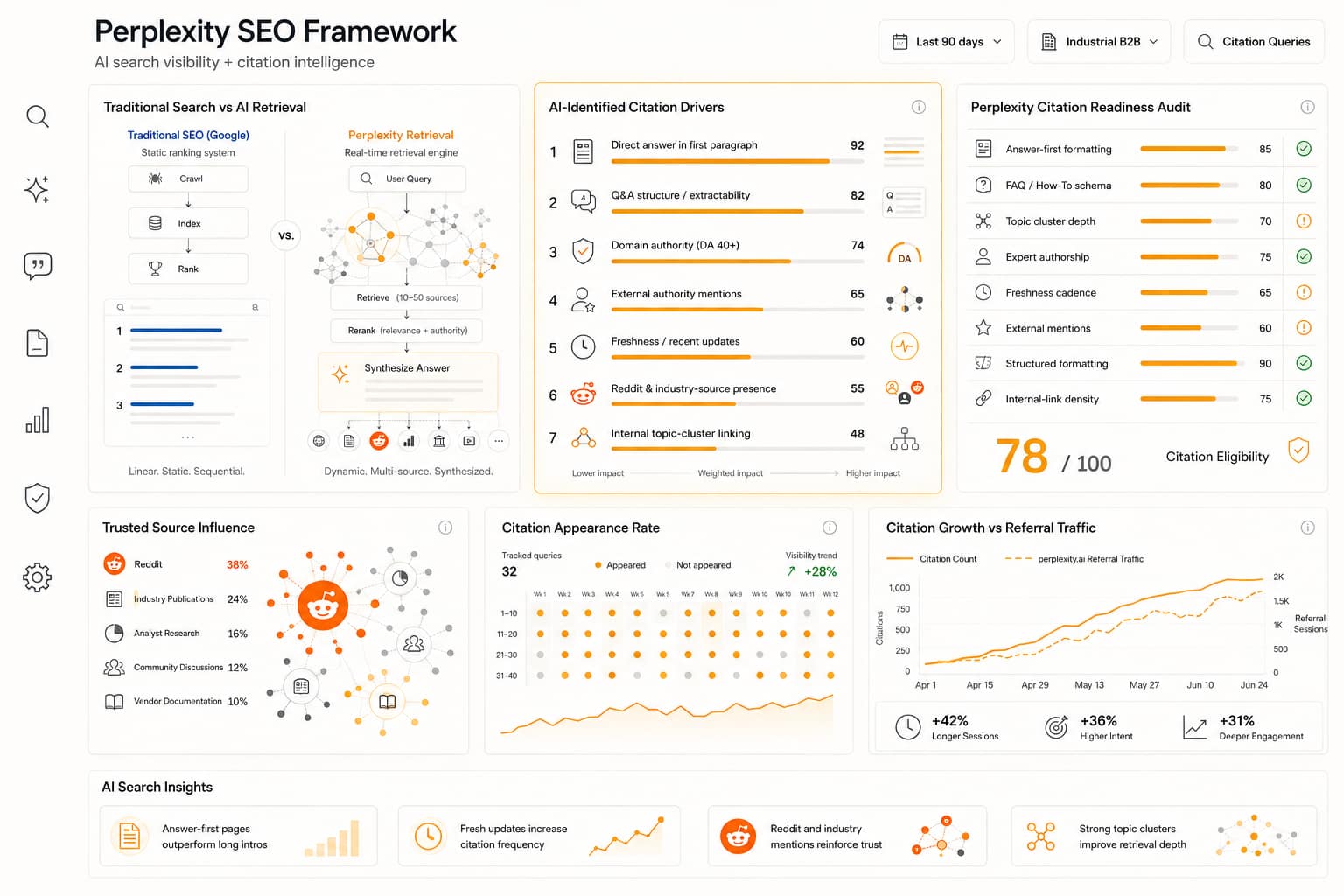
- Real-time retrieval, not crawl-index-rank. Perplexity executes a live web search on every query, retrieves 10-50 candidate sources, and reranks them in milliseconds against the user's question. No monthly update cycle to optimize against. A page updated yesterday competes directly against a page updated last year on the same query.
- Trust signals weighted differently. Perplexity heavily uses Majestic Trust Flow and Moz Domain Authority as retrieval filters, with sites at DA 40 or above cited roughly six times more frequently than sites under DA 30 (Otterly.AI 2026). At the same time, niche-specific deep content from lower-DA domains earns citations when it answers a query directly and the high-DA alternatives do not. Domain authority gets you into the candidate pool; content quality wins the citation slot.
Practical takeaway for B2B operators with DR or DA under 30: you are not locked out of Perplexity citations. You need to be sharper about which queries to target, more disciplined about answer-first structure, and more active about external citation building than competitors with higher domain trust.
How does Perplexity choose which sources to cite?
Synthesizing across multiple 2026 Perplexity analyses (Otterly.AI, LeadWalnut, Harbor, AI Rankings), citation selection comes down to four signals.
- Direct-answer prominence. Content that answers the query in the first paragraph wins citations. Otterly.AI reports 90 percent of winning citations provide a clear definition or direct answer within the first 100 words. Content that buries the answer in paragraph six loses to content that leads with it, even if the lead-with-it version is shorter or from a lower-authority domain.
- Structural extractability. Q&A and direct-answer formats earn a 55 percent top-three citation rate, compared with 31 percent for standard article formats (Otterly.AI). FAQ schema, How-To schema, and definition lists all signal extractability to the retrieval layer.
- External authority. Perplexity does not score domains in isolation. It looks at whether high-authority publications mention or link to the page, and whether the page's claims are echoed across other trusted sources. Reddit accounts for approximately 46.7 percent of Perplexity's top citation sources in our coverage queries (consistent with our prior platform GEO research). Industry publications, primary research from analyst firms, and active community presence all reinforce the trust signal.
- Freshness. Perplexity's reranker weights content updated within the last 2-3 days higher than content not touched for months. Outdated dates in URLs or copy (for example, "Updated for 2024") actively work against citation eligibility. Operators serious about Perplexity citations refresh pillar pages quarterly at minimum, monthly for high-priority topics.
What does a Perplexity SEO framework for B2B look like?
A layered approach for B2B operators auditing their Perplexity readiness.
- Layer one: answer-first content structure. Every B2B page targeting Perplexity citation needs the direct answer to the page's primary question in the first two to three sentences. No throat-clearing introduction. No "in this guide we will cover" preamble. The answer first, the explanation second. This is the single highest-leverage change for most B2B blogs.
- Layer two: structured data and Q&A formatting. Add FAQ schema to any page with a recurring set of buyer questions. Add HowTo schema for process-driven content. Use H2-level questions in the page body when the question is one a buyer actually types into Perplexity. The Q&A format outperforms standard article structure by 24 percentage points on top-three citation rate (55 percent vs 31 percent per Otterly.AI).
- Layer three: domain authority plus targeted external citation building. For B2B operators under DA 30, focus on getting cited in three to five industry publications per quarter. A single high-authority mention is worth more than ten low-authority backlinks. Tactics include contributing primary research that publications will cite, getting quoted in trade-press round-ups, and building a credible Wikipedia or Crunchbase entity profile. Reddit AMAs and community contributions also feed the off-platform authority signal.
- Layer four: freshness and update cadence. Pillar pages get reviewed and updated every 90 days. Show update dates visibly. Add a "Last updated" line to the top of every commercial-intent page. For posts targeting your top 10-15 commercial keywords, update monthly even if the changes are minor: a new statistic, a refreshed example, an updated source citation.
- Layer five: topical authority through clusters. Perplexity rewards depth on a topic. A single isolated post on "B2B CRM selection" performs worse than a cluster of 5-7 connected posts covering CRM evaluation criteria, comparison frameworks, implementation pitfalls, and migration playbooks. Internal linking between cluster posts signals topical depth to the retrieval layer.
How do you audit a B2B site for Perplexity citation readiness?
The audit we run when evaluating a B2B site's Perplexity readiness.
- Identify 20-40 priority queries that buyers in your category actually type into Perplexity. Use the "frequently asked" follow-up suggestions inside Perplexity itself as your starting list.
- For each query, run it in Perplexity and document which sources get cited today.
- Audit your top 10-15 commercial-intent pages: does each lead with the direct answer in the first 100 words?
- Check schema deployment: FAQ schema on FAQ-heavy pages, HowTo schema on process pages, Organization schema across the site.
- Pull your domain's "last updated" distribution: how many pillar pages have been touched in the last 90 days?
- Audit external citation profile: count mentions in industry publications over the last 12 months; identify the top 3-5 outlets to target this quarter.
- Check Reddit and community presence: is your brand named in relevant subreddit discussions? Are you participating?
- Set up referral tracking in GA4 filtered for perplexity.ai source to baseline current click-through volume.
The audit takes a focused operator about three days. The fixes take 30-60 days depending on the gap size.
How do you measure Perplexity citation performance?
Traditional rank tracking does not apply. Four metrics that do.
- Referral traffic from perplexity.ai in GA4. The bottom-line metric. Filter Acquisition reports by Source = perplexity.ai. The traffic will be lower-volume than Google but typically higher-intent: longer session duration, more pages per session, higher conversion rate on commercial-intent paths.
- Citation appearance rate on your target query set. Run your 20-40 priority queries weekly. Track how many cite your domain. Movement on this number, even from 0 to 3 citations across 40 queries, signals optimization is working.
- External citation count growth. Track the count of high-authority publications mentioning your brand month over month. Perplexity cannot cite you for a claim it has not seen anywhere else.
- Internal-link density across topic clusters. A topical cluster with strong internal linking signals depth. Track the average internal-link count per pillar page.
Citation frequency drives up to 35 percent of AI answer inclusions for a domain (LeadWalnut 2026). The flywheel: each citation feeds the next. The first 5-10 citations are the hardest. Once Perplexity has seen your domain cited consistently across multiple queries, the marginal cost of additional citations drops.
How do you track which sources Perplexity cites in your category?
Keep a fixed list of 20 to 40 buyer questions, run each one in Perplexity on a set day every month, and log every cited domain with the date and a screenshot. Run each question more than once: AI answers are not deterministic, and in our own checks on other engines the same prompt has returned a brand in one run and left it out in the next, so a dated screenshot is the only record that holds up. After two or three months the log shows which publications Perplexity keeps citing in your category. Those are the sites to earn mentions on. Our AI citation tracking guide covers the monthly method across engines.
Perplexity SEO: frequently asked questions
What on-page signals does Perplexity use to decide which URL to cite?
Perplexity does not publish a ranking formula. Its help center says it searches the web in real time, summarizes what it finds, and attaches numbered citations that link to the original sources. The published analyses listed under Sources agree on three on-page patterns: a direct answer in the first 100 words, question-style headings, and recently updated content. Access comes first: Perplexity's crawler documentation recommends allowing PerplexityBot in robots.txt for a site to appear in its results.
How do you rank higher in Perplexity?
There is no position to claim; each answer is assembled per query. Allow PerplexityBot in robots.txt and in your firewall (Perplexity's docs include firewall allow rules for this), lead each page with the direct answer, use headings phrased the way buyers ask, keep key pages updated, and earn mentions on the sites Perplexity already cites in your category. In our own audits of equipment dealer websites, bot protection on several sites blocked automated visits, so test access through the firewall, not only in robots.txt.
What are Perplexity SEO best practices in 2026?
The five layers above, in short: answer the question in the first two or three sentences, format pages as questions and answers with matching schema, build external mentions in the publications your buyers read, review pillar pages every 90 days and show the update date, and cover a topic with a linked cluster of posts rather than one isolated page.
What are Perplexity's official search features?
Per Perplexity's help center: every answer carries numbered citations that link to the original sources; Pro Search runs more in-depth answers and lets subscribers choose the model; Research runs dozens of searches, reads hundreds of sources, and returns a report in two to four minutes; and follow-up questions keep the context of the conversation. Source: Perplexity Help Center, "How does Perplexity work?", accessed September 24, 2026.
Key takeaways
- Perplexity SEO is citation-based, not position-based. The retrieval-and-rerank mechanic looks fundamentally different from Google's crawl-index-rank model and rewards different content.
- 90 percent of winning citations lead with the direct answer in the first 100 words. The single highest-leverage change for most B2B blogs is restructuring the intro of every commercial-intent page.
- Domain authority gets you into the candidate pool (DA 40+ cited 6x more often per Otterly.AI), but content quality and Q&A structure determine which candidate wins the citation slot (55 percent top-three citation rate for Q&A vs 31 percent for standard articles).
- Off-platform signals matter as much as on-page work: Reddit accounts for 46.7 percent of Perplexity's top citation sources, industry publications reinforce trust, and freshness (content updated within 2-3 days) materially boosts retrieval weighting.
- Measure by referral traffic in GA4, citation appearance rate on your priority query set, and external citation count growth. Traditional rank tracking does not apply.
Perplexity SEO in 2026 is the discipline of getting cited as a source inside an AI-generated answer, not ranking in a list of blue links. Perplexity retrieves real-time web content, scores it against the query, and cites 3-8 sources directly in its answer. The four signals Perplexity uses to pick citations are direct-answer prominence (90 percent of winning citations lead the answer in paragraph one), structural extractability (Q&A and FAQ schema formats earn 55 percent top-three citation rate versus 31 percent for standard articles), external authority (Reddit accounts for 46.7 percent of top citation sources, industry publications reinforce domain trust), and freshness (content updated within 2-3 days gets a reranker boost). B2B operators should build their Perplexity SEO around five layers: answer-first content structure, structured data and Q&A formatting, domain authority plus targeted external citation building, a 90-day pillar update cadence, and topical cluster depth. Measurement uses GA4 referral traffic filtered for perplexity.ai, citation appearance rate on a 20-40 priority query set, and external citation count growth, not traditional rank tracking.
If you want a baseline read on where your site stands across Perplexity, ChatGPT, Google AI Overviews, and Gemini, run the free AI Visibility Audit at synapseedge.com/tools/ai-visibility-audit. The 25-question audit takes about 8 minutes and scores your site across the five layers above: answer-first structure, structured data, external authority, freshness, and topical cluster depth.
Sources
- Otterly.AI, "Perplexity SEO (2026): How to Rank by Getting Cited as a Source (Not Just #1)": primary source for citation-rate by format, DA correlation, direct-answer prominence findings.
- LeadWalnut, "Perplexity SEO: How to Get Cited in AI Search Answers (2026)": buyer behavior data (52 percent of B2B buyers using Perplexity for vendor research) and citation frequency flywheel observation (citation frequency drives up to 35 percent of AI answer inclusions).
- Harbor SEO, "How to Rank in Perplexity AI (2026 Complete Guide)": content freshness and external authority signal corroboration.
- Synapse Edge prior research, "Platform GEO: Why the Same Strategy Works on Perplexity and Fails on ChatGPT" for the Reddit 46.7 percent citation-source finding originally documented across coverage queries.
- Ahrefs Keywords Explorer, US market data, May 2026, for keyword opportunity assessment ("perplexity seo" KD 4, volume 400; "llm seo" KD 12, volume 1,400; "answer engine optimization" KD 44, volume 3,700).