Open ChatGPT right now. Type: "Who are the best [your service category] providers in [your region]?"
If your company does not appear in the answer, or appears without the depth of a competitor who does, that interaction just formed a buyer preference without your website ever being visited. No impression counted. No click recorded. No remarketing pixel fired.
The buyer moved on with a view of your market that you had no input into.
This is not a hypothetical future problem. It is happening now, at increasing scale, in every B2B category. And the companies paying attention to it are building a compounding visibility advantage over competitors who are still optimizing exclusively for Google page one.
What actually changed, and what didn't
The most important thing to understand about AI search is what it disrupted and what it left untouched. Both matter equally for building the right strategy.
What changed
AI Overviews, the generated summaries that appear at the top of many Google searches, now absorb approximately 98% of informational queries. When someone asks "how does hydraulic equipment work" or "what is a drip email sequence", they receive a synthesized answer directly on the search results page. They do not click. The content creator who ranked #1 for that query loses those impressions entirely.
Research from Ahrefs confirmed in 2025 that when an AI Overview appears for a query, the #1 organic result loses approximately 34% of its expected clicks. For informational content, which makes up the majority of most B2B blog strategies, this represents a structural revenue loss for content-heavy SEO approaches.
Additionally, over 50% of all Google searches are now zero-click. The search engine has evolved from a referral engine into an answer engine. The user behavior shift follows: from "search → click → browse" to "ask → read → decide".
Perhaps most significantly for B2B: an entirely new search surface has emerged. ChatGPT reached approximately 900 million weekly users by late 2025. Perplexity, Gemini, and Claude are growing rapidly. These platforms are where an increasing segment of business buyers conduct their initial research, and they operate entirely outside the traditional SEO measurement framework. There are no impressions reports. No click-through rate data. No rank tracking.
What did not change
The fundamentals of authority building remain constant, and are now more important than ever.
Search intent still determines buyer behavior. A buyer searching "Cat 320 excavator rental Los Angeles" is ready to act. AI does not change what that person needs; it changes where they look first. Commercial-intent queries (transactional, local, product-specific) are still dominated by traditional search results. This is where B2B pipeline comes from.
Brand trust still drives conversion. A buyer who encounters your brand multiple times, in search results, in AI answers, in industry publications, and in LinkedIn, is significantly more likely to convert. The mediums have multiplied; the psychology has not.
Links, structured authority, and content quality still determine who gets cited. The mechanism by which AI chooses sources is fundamentally similar to how Google has always worked: authority signals, content clarity, structured data, and topical depth. The ranking surface changed. The underlying factors that determine who appears on it did not.
You do not need to abandon your SEO strategy. You need to expand it. The infrastructure built for traditional SEO (authoritative content, backlinks from credible sources, technical site health, structured data markup) is the same infrastructure that determines AI visibility. They are not separate projects. They are the same project with an additional layer.
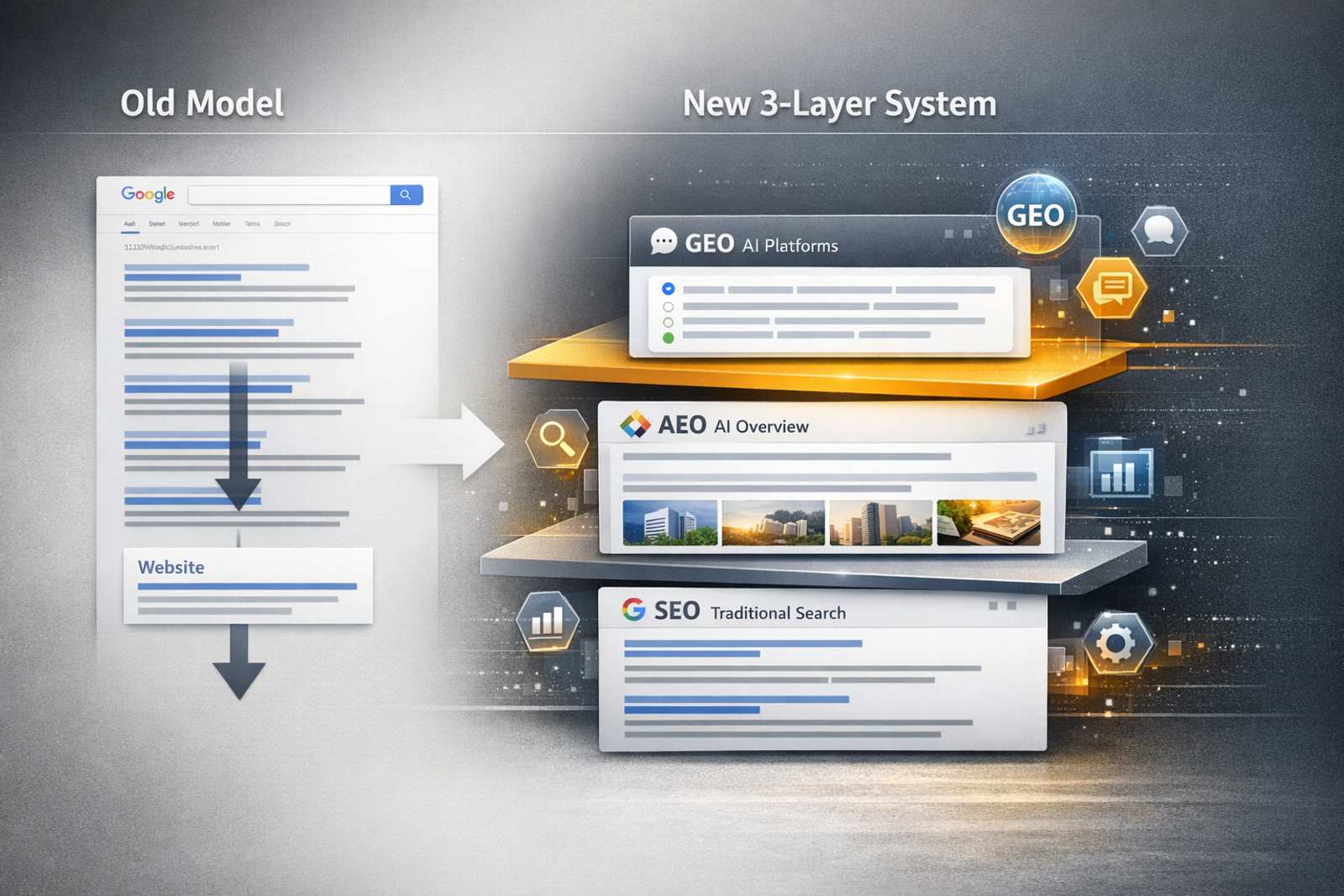
The three-layer visibility model
In 2026, B2B search visibility operates across three distinct but interconnected layers. Most companies are investing in one. High-performers are building all three.
Layer 1: SEO. Getting pages to rank and earn clicks
This is the layer most B2B companies understand and invest in. Target commercial-intent keywords. Build category and product pages with depth. Earn backlinks from relevant sources. Fix technical errors. Maintain Core Web Vitals.
The strategic shift required in 2026: focus SEO investment on the queries that AI is not absorbing. Commercial-intent queries ("Cat 320 for sale California", "CRM audit firm Chicago", "equipment rental near me") remain heavily non-AI in search results. These are where your pipeline comes from. Double down on them.
Pull back on informational content created primarily to rank for broad "how to" or "what is" queries. AI Overviews have absorbed these. The traffic is gone. Informational content still has a role, but its value now lies in establishing the topical authority that earns AI citation, not in generating direct organic traffic.
Layer 2: AEO. Getting content extracted into direct answer boxes
Answer Engine Optimization focuses on appearing in Google AI Overviews, Featured Snippets, and "People Also Ask" results. The user may not click, but your brand appears as the source of the answer. This is zero-click brand exposure at scale.
The primary mechanism is answer-first content structure: writing so that the first 2–3 sentences of any page directly answer the primary question, before any context, qualification, or company description. AI extracts from the top of the page. Pages that open with "Company X offers..." are structurally invisible to AI extraction.
Supporting elements: FAQ schema markup on key pages, H2 subheadings phrased as questions, short structured paragraphs, and a standalone summary section at the end of each article that functions as a complete answer on its own.
Layer 3: GEO. Getting cited inside AI-generated responses
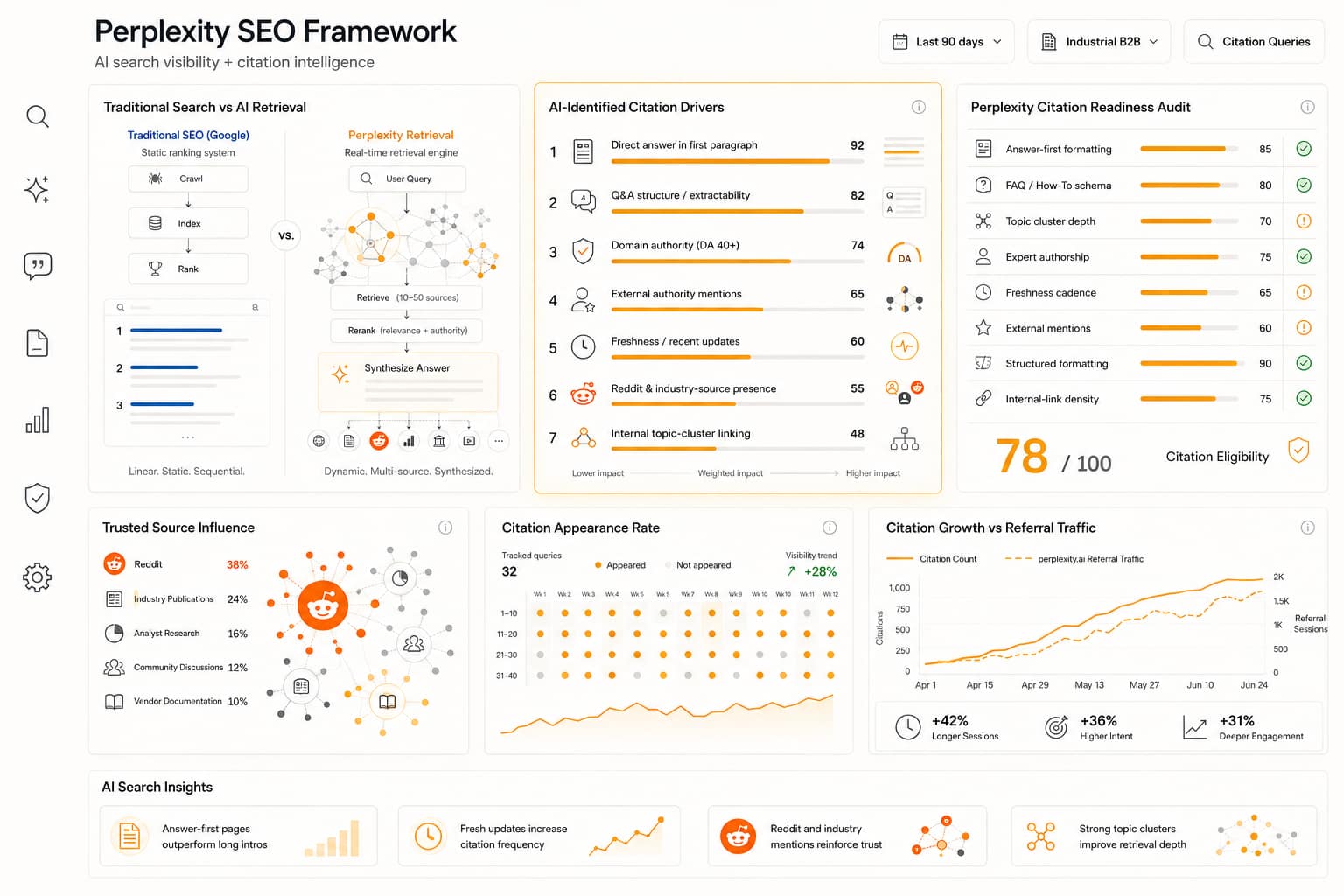
Generative Engine Optimization (GEO) is the newest and least understood of the three layers. It focuses on ensuring your brand is cited, by name, with attribution, when buyers ask ChatGPT, Perplexity, Gemini, or Claude about your category, product type, or service area.
A buyer who asks an AI platform "who are the most credible [service type] firms in [region]" and receives a list that does not include you has formed a market view that excludes you, before ever visiting Google.
GEO is determined by three factors:
- Authority signals: dofollow backlinks from credible, relevant sources; mentions in industry publications and directories; a consistent brand footprint across the web
- Content structure: answer-first writing, clear subheadings, FAQ schema, short structured paragraphs. AI models are extraction engines that prefer content organized in predictable structures
- Freshness and relevance: recently published and updated content, named authors with real credentials, original data and case studies that no other source provides
What this means for B2B companies in high-ticket sectors
Research happens before anyone calls
In a category where a single transaction might be worth $50,000 to $2 million, buyers research extensively before making contact. AI platforms are becoming a primary research tool for the discovery phase, before buyers have formed strong vendor preferences.
The company that appears in that AI-assisted discovery phase establishes a brand recognition and implicit trust signal that carries through the entire subsequent buyer journey. The company that doesn't appear has to work harder to earn trust at every subsequent touchpoint.
Local and territorial visibility is still a traditional SEO story, for now
"Cat excavator rental Bakersfield" and "equipment dealer near me" queries still produce standard Google results dominated by non-AI responses. Commercial and transactional-intent searches are the last major domain where traditional SEO remains the primary visibility mechanism.
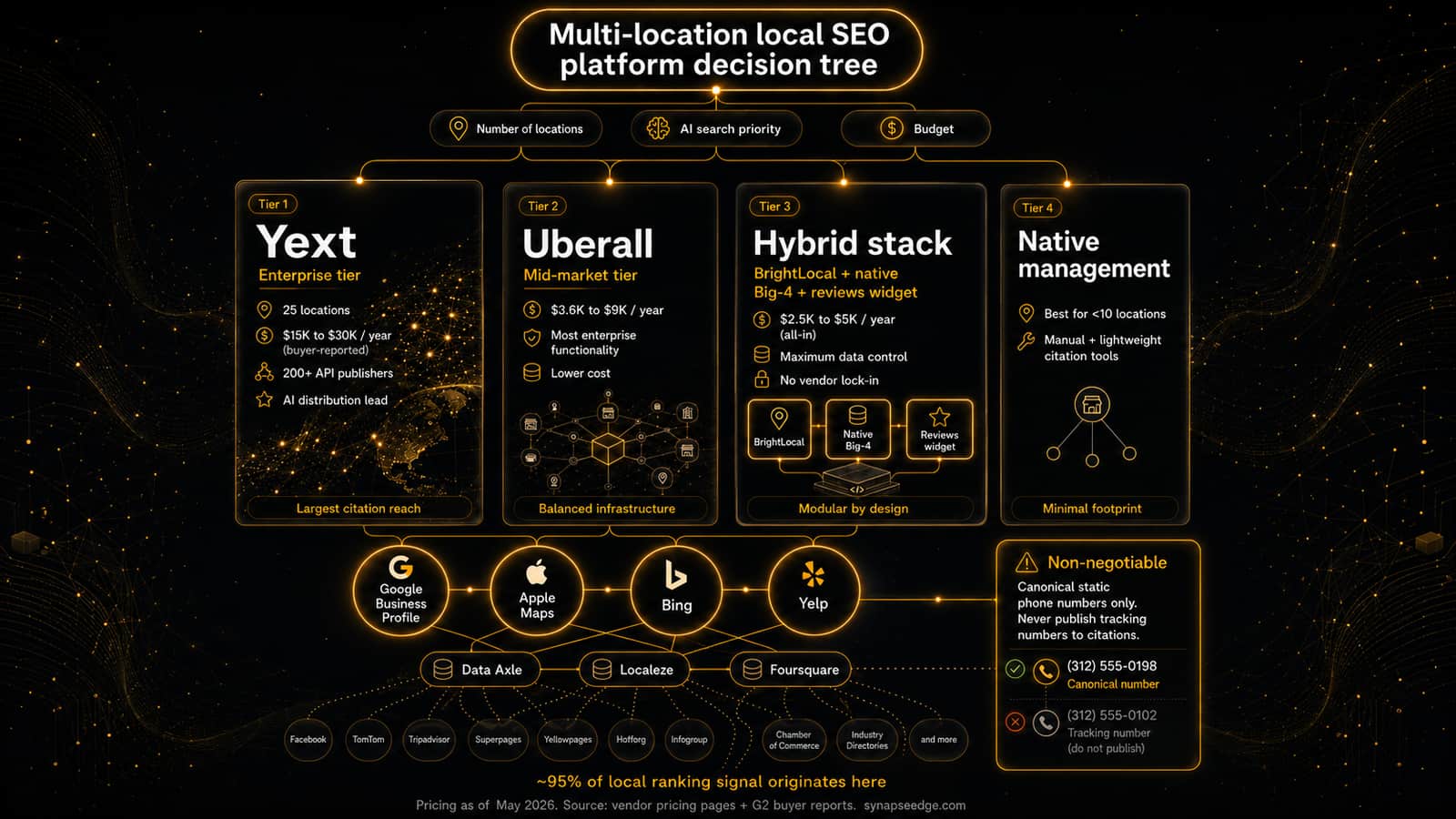
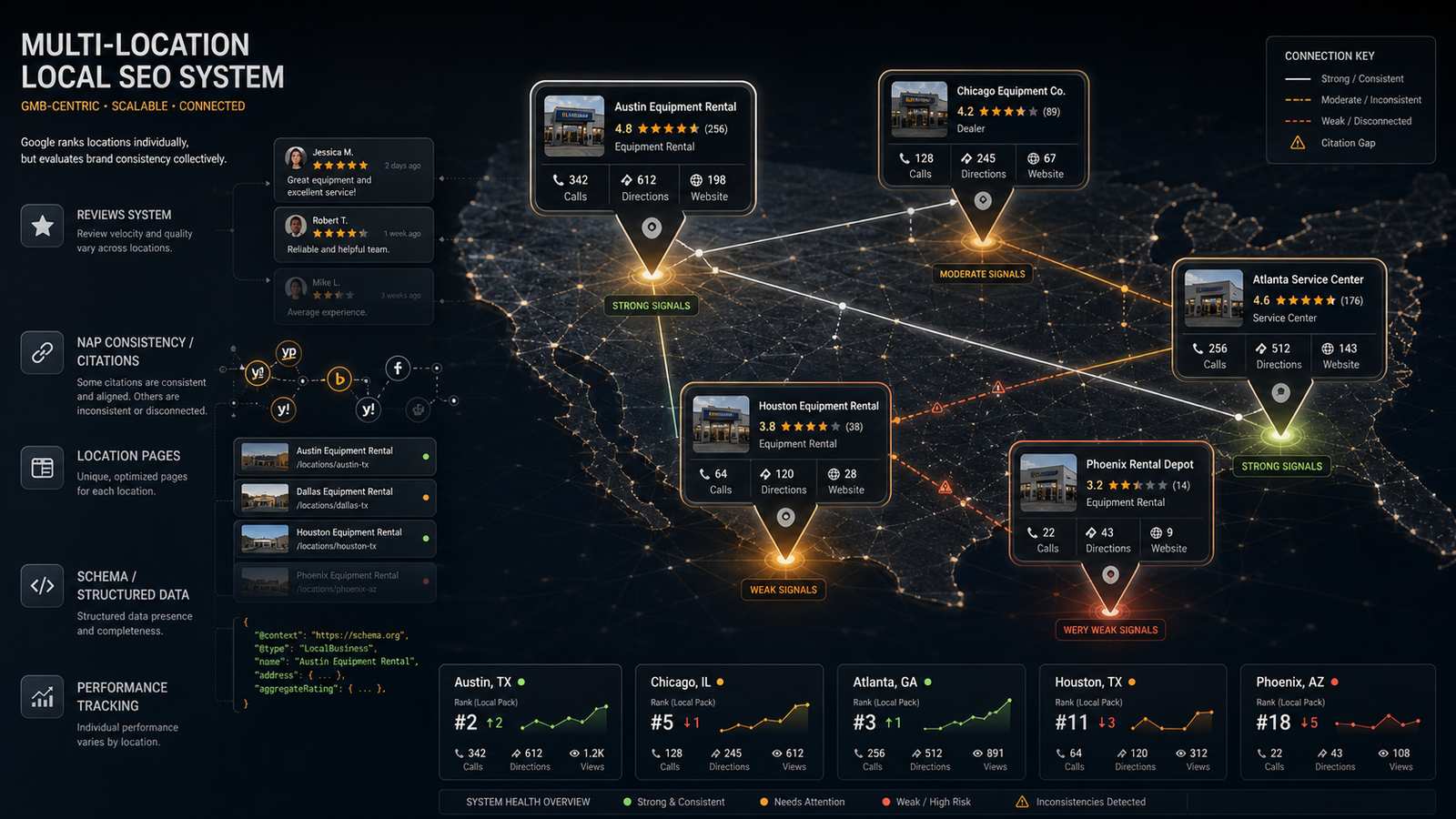
This is where B2B pipeline comes from in the near term. Protecting and expanding this visibility should be the highest SEO priority. It is also, not coincidentally, where most B2B companies have the largest competitive gaps: local page architecture, Google Business Profile optimization, and location-specific content are chronically underinvested.
AI visibility builds compounding brand authority
AI models are trained on web content. The companies that are mentioned frequently, cited in credible sources, and whose content is structured for AI extraction are building a training-data footprint that will compound over the coming years. Companies that have not built this footprint will require significant effort to catch up, effort that will be more expensive and time-consuming when AI search has matured further.
From client work: In a competitive analysis for a multi-location Cat® dealer in California, we found that their primary competitor appeared in ChatGPT answers for 7 out of 10 commercial queries we tested, despite having comparable organic SEO metrics. The difference was off-site brand presence: more industry directory listings, more mentions in regional construction media, more Google review volume, and more consistent NAP data across citation sources.
A practical starting point: the GEO readiness audit
Before any strategy is built, I recommend the same starting point for every B2B company concerned about AI visibility: a 15-minute self-audit across five dimensions.
1. Brand presence check
Search your company name in ChatGPT, Perplexity, and Google AI Overviews. Search your primary service or product category plus your region. Screenshot what appears and what doesn't. This is your current GEO baseline.
2. Technical access verification
Check your robots.txt file. Verify that GPTBot (OpenAI), ClaudeBot (Anthropic), and PerplexityBot are not blocked. This is the most common and easily fixed technical GEO error, and it completely prevents AI platforms from crawling your content.
3. Content structure review
Open your five highest-traffic pages. Read the first three sentences of each. Do they directly answer the primary question a buyer would have? Or do they describe the company? Answer-first structure is the single highest-leverage content change for both AEO and GEO.
4. Authority signals inventory
Count your dofollow referring domains. List the industry directories and publications where your company is mentioned. Count your Google reviews across all locations. These are the off-site authority signals that AI models use to assess credibility, and the same signals that determine whether you appear in AI answers.
5. Schema markup audit
Check whether FAQ schema, Article schema with named authors, and LocalBusiness schema are implemented on relevant pages. Schema markup is machine-readable structure that both Google AI Overviews and third-party AI platforms can extract and use.
If you complete this audit and find significant gaps, the good news is that most of them are fixable within 30–60 days. The infrastructure required for traditional SEO authority (content depth, technical site health, backlinks, structured data) overlaps heavily with what GEO requires. You are not starting from scratch. You are extending existing work.
Key takeaways
- SEO is not dead, but it is now one layer of a three-layer visibility system: SEO (traditional rankings), AEO (featured snippets and AI Overviews), and GEO (citations in AI-generated responses).
- AI Overviews have absorbed ~98% of informational search queries. The strategic shift: protect commercial-intent traffic, reduce informational content created primarily for traffic volume.
- GEO is determined by authority signals (backlinks, mentions, directory presence), content structure (answer-first, FAQ schema, structured subheadings), and freshness (named authors, updated content, original data).
- In high-ticket B2B, AI search visibility builds compounding brand authority in the discovery phase, before buyers have formed strong vendor preferences. Early movers have a window advantage.
- The GEO audit takes 15 minutes. Start with robots.txt (are AI crawlers blocked?), content structure (does your first sentence answer the primary question?), and brand presence (search your company in ChatGPT right now).