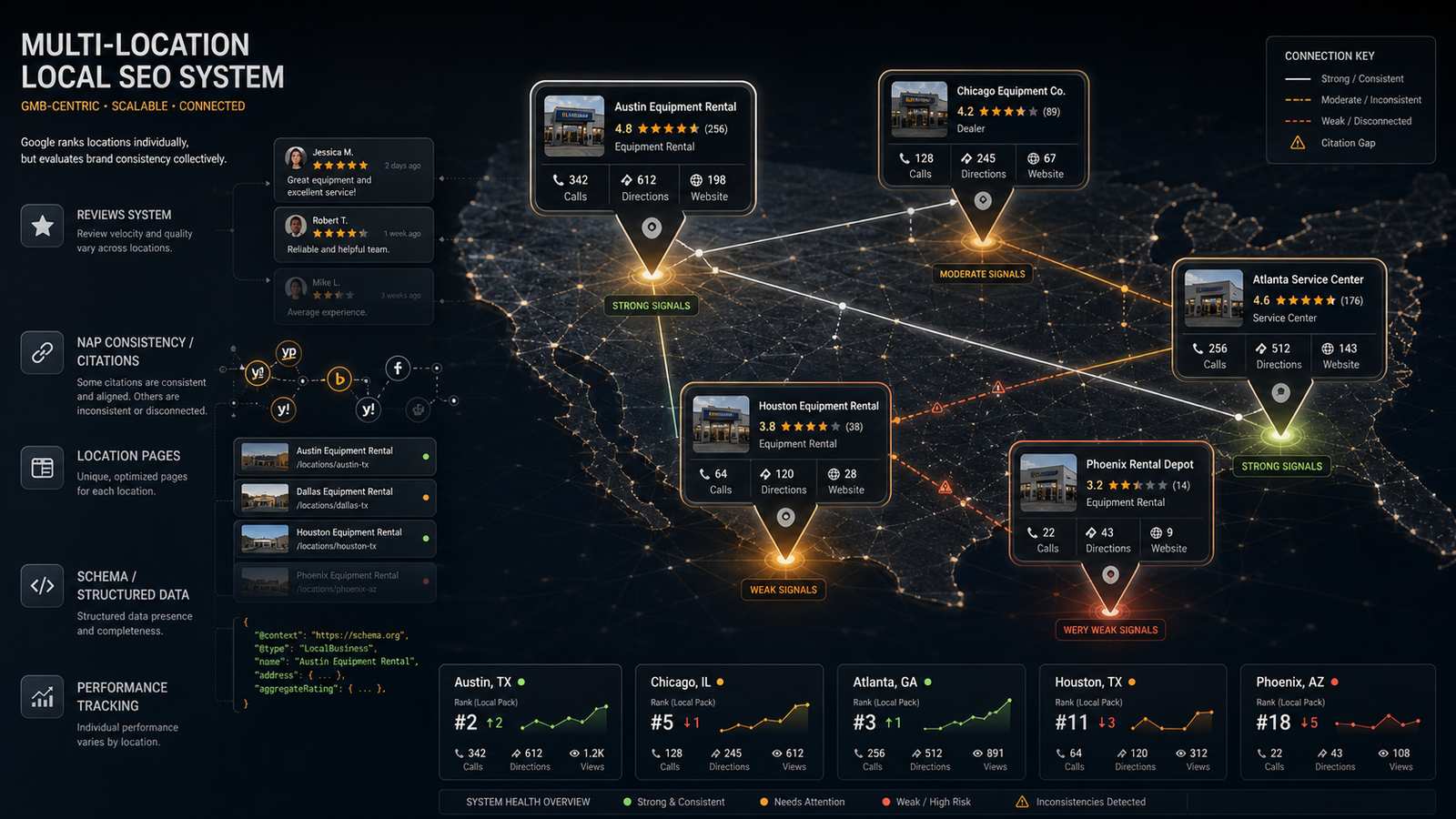
Yext vs Uberall comes down to scale and budget. Yext is the enterprise option: its own site lists 200+ direct publisher integrations and custom, per-location pricing billed annually, built for hundreds to thousands of locations. Uberall covers the same core jobs (listings, reviews, locator pages, and AI search tracking) for mid-market multi-location brands, lists 150+ directories, and also prices on request. Below either, a hybrid stack of BrightLocal plus native management of Google, Apple, Bing, and Yelp covers the listing work that drives local rankings. The right pick depends on how many locations you run, how much AI search visibility matters to you right now, and whether the platform keeps call-tracking numbers out of your citations.
Vendor facts in the comparison table and FAQ below come from each vendor's own website, accessed September 24, 2026. Most vendors in this category quote prices only after a sales call, so this post compares features and pricing models, not dollar figures. Get current quotes before procurement.
This is a cluster post under the multi-location local SEO pillar guide. The pillar covers what to operate; this post covers what to operate it with, and how to pick at your scale and budget.
Yext vs Uberall at a glance (plus Localeze and BrightLocal)
| Yext | Uberall | Localeze (TransUnion) | BrightLocal | |
|---|---|---|---|---|
| What it is | Enterprise listings, pages, and reviews platform | Multi-location listings, reviews, and local pages | Data aggregator that feeds business data to platforms and directories | Local SEO toolkit: citations, rank tracking, Google Business Profile audits |
| Pricing (vendor site) | Custom. Priced per location, billed annually, better rates for multi-year terms | Three plans (Show Up, Stand Out, Connect), price on request | Not listed on its site | Track, Manage, and Grow plans, price on request. Citation Builder is pay-as-you-go per citation |
| Network (vendor claim) | 200+ direct publisher integrations, including Google, Apple Maps, Yelp, ChatGPT, and Gemini | 150+ directories, including Google, Apple Maps, Bing, and Yelp | Partnerships with 80+ search platforms, directories, navigation systems, and apps | Active Sync for business data (Manage plan) |
| Reviews | Monitors, responds to, and requests reviews across 80+ platforms | AI-assisted review responses | Not listed | Monitoring, responses, and review collection (Grow plan) |
| Locator pages | Yes (Pages) | Yes (locator and local pages) | Not listed | Not listed |
| AI search | Pushes brand data directly to publishers and AI assistants | Tracks share of voice in AI answers (GEO Studio) | Not listed | Local AI Visibility Tracker (all plans) |
Where Yext is ahead on paper: the largest direct publisher network in this set (200+ against Uberall's 150+) and a commercial model built for thousands of locations. Where Uberall fits better: mid-market brands that want listings, reviews, and locator pages in one tool without an enterprise contract. Localeze does a different job. It is an aggregator that directories pull from, not a dashboard you manage listings in, so it complements a platform rather than replacing one.
The four platform tiers
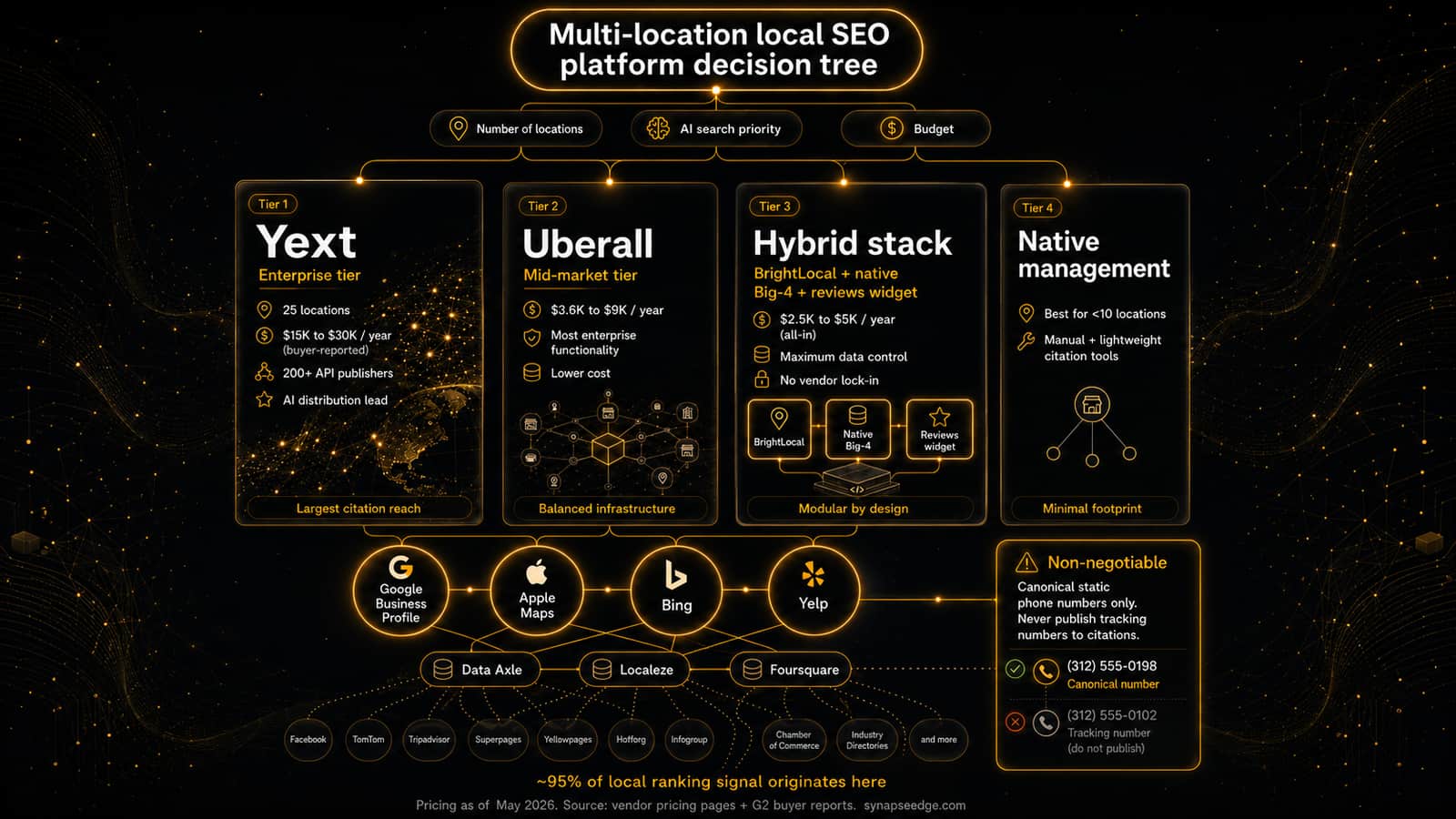
Multi-location listing platforms cluster into four operational tiers. The differences between tiers are publisher network depth, AI search readiness, pricing model, and the cost of the operational labor not covered by the platform.
- Tier 1, Enterprise (Yext): 200+ direct publisher integrations, AI search distribution, custom per-location pricing billed annually. Built for hundreds to thousands of locations.
- Tier 2, Mid-market (Uberall, Moz Local): Uberall lists 150+ directories and prices on request; Moz Local sells self-serve plans and a custom Enterprise plan for 50+ locations, each covering 90+ listing directories. Built for the 25 to 100 location range.
- Tier 3, Hybrid stack (BrightLocal + native Big-4 + dedicated widget): the lowest tool cost of the three, with internal labor covering the four native interfaces. Trades single-dashboard convenience for cost and full data control.
- Tier 4, Manual (under 10 locations): native interfaces for GBP, Apple, Bing, Yelp, plus a budget citation push tool. Tractable below 10 locations.
Why the Big-4 directories carry most of the signal weight
Local pack rankings are driven primarily by four data sources: Google Business Profile, Apple Business Connect, Bing Places, and Yelp. These four are the platforms Google uses to establish entity confidence for local businesses. The 100+ niche directories that listing platforms boast about feed downstream from three aggregators: Data Axle, Neustar Localeze, and Foursquare.
For platform selection, this means a tool that pushes to the three aggregators handles most of the niche directory propagation automatically. Direct API to the Big-4 plus aggregator coverage equals full functional coverage for ranking purposes. The expanded 200+ direct publisher count Yext leads with covers the long tail more cleanly. The long tail matters most when AI search visibility is a strategic priority, and least when it is not.
Where Yext is still worth the premium
Three capabilities Yext does better than anyone else.
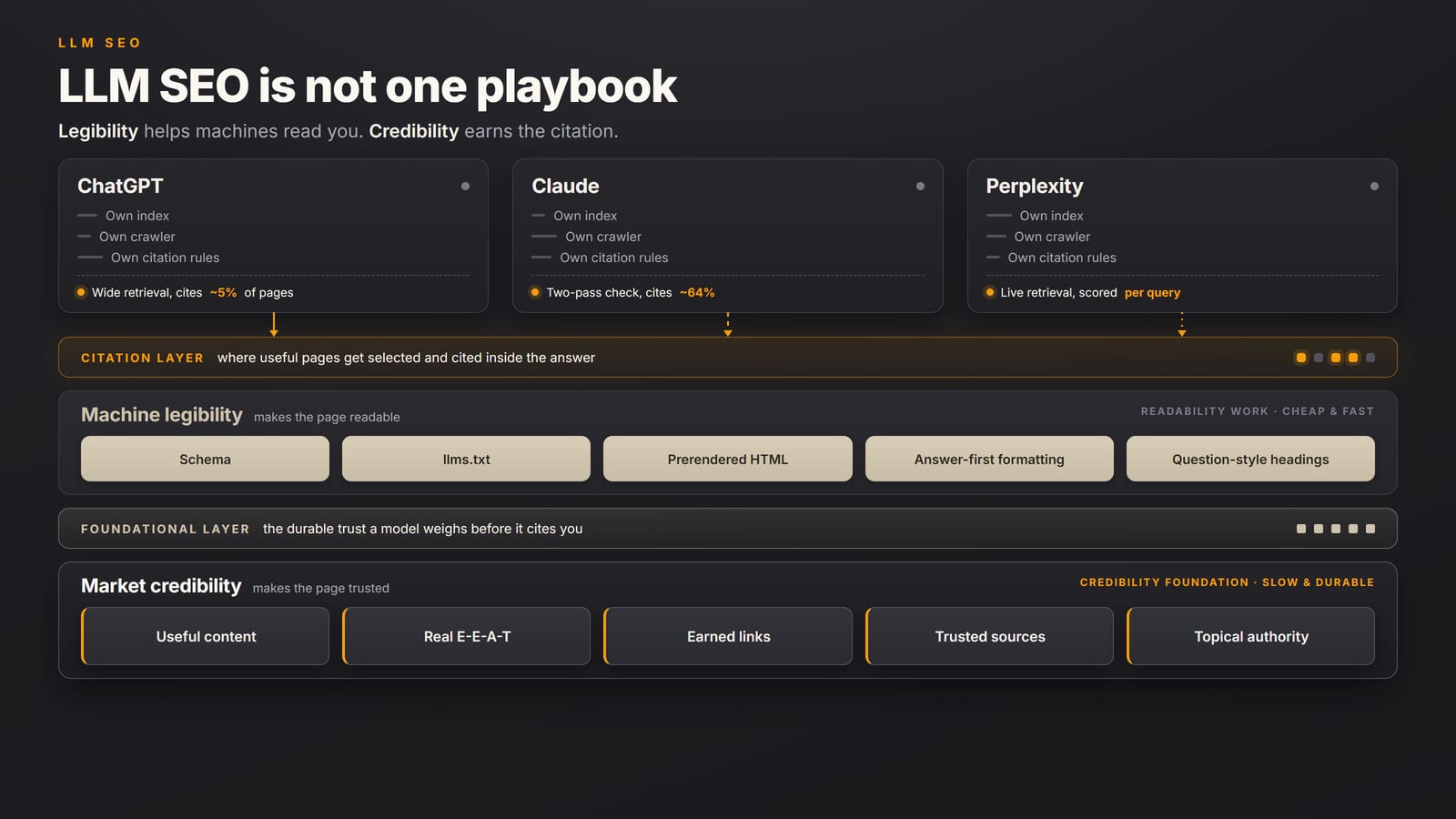
- AI search and Knowledge Graph distribution: Yext has invested heavily in pushing structured entity data into the systems that feed ChatGPT, Perplexity, Gemini, and Google AI Overviews. Based on each vendor's published AI search positioning as of May 2026, mid-market platforms appear to be behind on this specific capability.
- Enterprise audit logs and role-based permissions: for operators that need to prove to legal, compliance, or franchisees what data was published where and when, Yext's audit trail is the most mature in the category.
- Duplicate suppression at scale: when a brand has years of orphaned listings, fake duplicates, or aggregator artifacts, Yext's suppression engine cleans them up faster than any alternative.
The trade-off is the "data rental" risk. Yext owns part of the publisher distribution layer. Users report on G2 and in industry forums that on contract exit, some publisher relationships revert to whatever data those publishers had before Yext took over. For brands that may switch providers in the future, this is a real cost worth budgeting for.
Where Uberall hits the sweet spot
Based on each vendor's public feature documentation, Uberall covers most of Yext's core functionality for footprints in the 25 to 100 location range. Both price on request, so compare quotes at your own location count. Direct APIs to the Big-4 (Google, Apple, Bing, Yelp), aggregator coverage, bulk hours and post management, an embedded reviews widget, per-location reporting.
Where Uberall is still behind Yext: AI search distribution is "emerging" rather than mature. If a brand's local SEO strategy depends specifically on appearing in AI Overviews and being cited in ChatGPT answers, this gap moves the decision back toward Yext. If AI search visibility is "important but not critical right now," Uberall is the better value.
Operational fit: Uberall was built for multi-location operators in the 25+ range. Pricing is location-based, not entity-based, which matters for businesses that run multiple division-level GBP listings per physical location (sales, service, parts, rental at the same address). Yext's entity-based pricing tends to multiply faster in those configurations.
When the hybrid stack is the right call
Three components, each focused on the job it does best:
- BrightLocal (plans priced on request, Citation Builder pay-as-you-go per citation): citation auditing, NAP consistency tracking, distribution to the three major aggregators, monthly audit reports, rank tracking. The system of record for what is published where.
- Direct native management of GBP, Apple Business Connect, Bing Places, and Yelp (free plus labor). These four carry the signal weight, and managing them directly removes any data-rental risk.
- A dedicated reviews widget (Trustindex, EmbedSocial, Reviews.io): a flat subscription, purpose-built for the widget job, better Core Web Vitals performance than widgets bundled inside listing platforms.
Cost: one BrightLocal subscription, one widget subscription, and internal time for governance across the four native interfaces. What you give up: a single dashboard for bulk hours and posts, automated review response in one inbox, AI search distribution. What you keep: NAP governance and audit (BrightLocal is excellent at this category), full data control with no vendor lock-in, and budget headroom for schema work, content, or a future upgrade if scale changes.
This stack is the right answer when the budget ceiling is firm, when operational discipline is in place to manage four native interfaces directly, or when avoiding vendor lock-in is itself a strategic priority.
The non-negotiable that breaks platform decisions
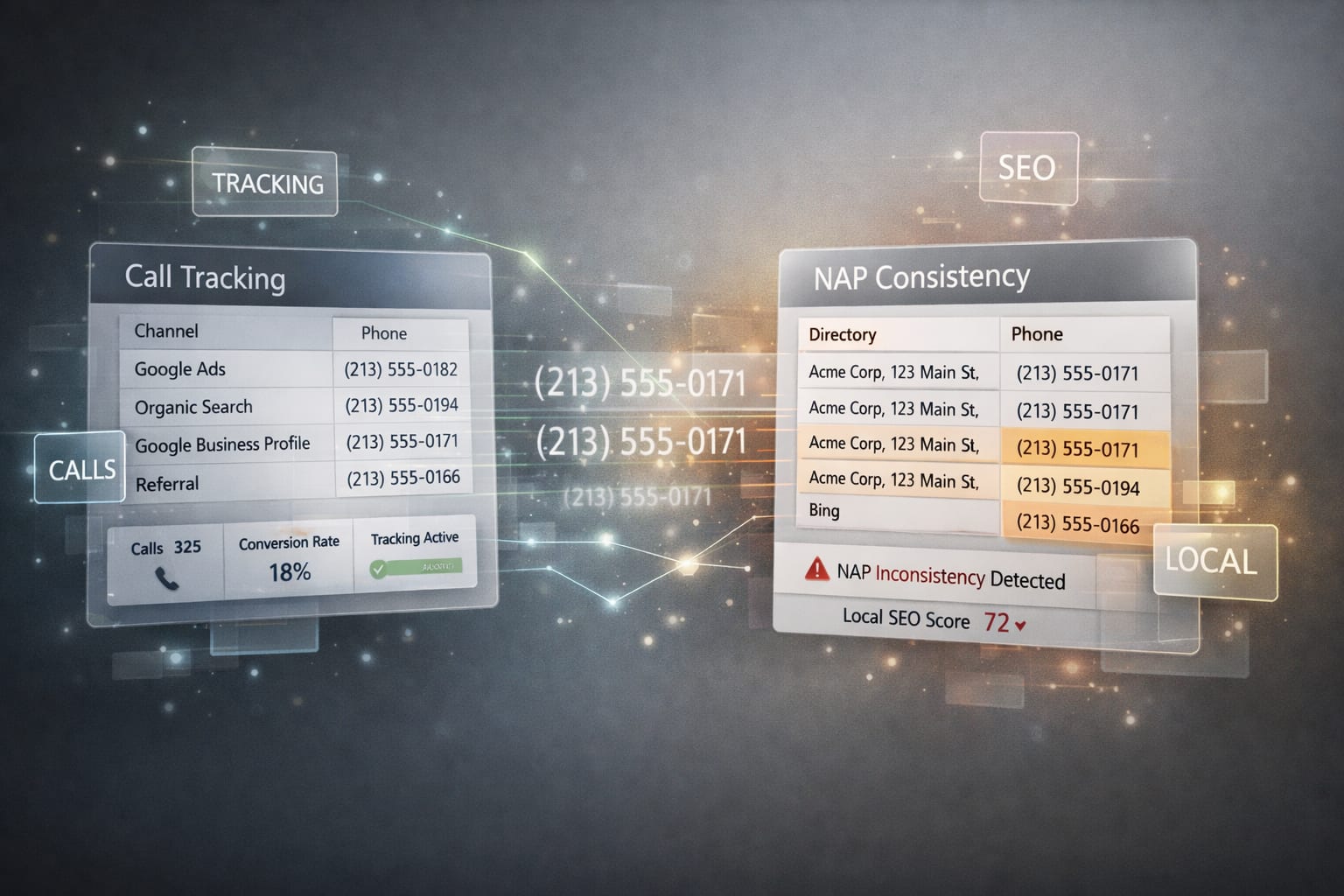
Whichever tier you pick, the platform must publish canonical static phone numbers (not call-tracking numbers) to external citations. Some platforms force a single "Primary phone" field per location and push that phone everywhere by default. If the brand uses Dynamic Number Insertion for call tracking, the canonical NAP phone number must remain the static branch number on every external surface: GBP, Apple, Bing, Yelp, aggregators, and schema markup.
Tracking numbers belong only on surfaces Googlebot does not read as citations: dynamic swap on the website via DNI, click-to-call buttons in paid ads, SMS short codes in campaigns. A platform that pushes a tracking number into external citations breaks NAP consistency the day it goes live. Validate this in the demo, not after contract signing.
A simple decision tree
- 50+ locations, AI search visibility is a top-3 strategic priority, budget supports an enterprise contract: Yext.
- 10 to 50 locations, a mid-market budget, AI search is important but not strategic: Uberall.
- A firm budget ceiling and the discipline to manage four native interfaces directly: hybrid stack (BrightLocal + native Big-4 + dedicated widget).
- Under 10 locations: manual native management plus a budget citation tool is often sufficient.
The wrong move is paying enterprise pricing for capabilities the business does not need yet. The other wrong move is staying fully manual past 15 locations and trying to keep up via brute force; the labor cost outruns any platform fee inside a year.
Synapse Edge is a B2B revenue infrastructure consultancy, not a software vendor. We evaluate and integrate local SEO platforms as part of broader commercial architecture work, not as a standalone tooling exercise. The platform decision is downstream of the operational systems it has to support; if those systems are not defined, no platform can fix it.
Yext alternatives: Moz Local and Birdeye
If Yext and Uberall are both more platform than you need, two alternatives come up most often. Moz Local sells three self-serve plans (Lite, Preferred, Elite), each covering 90+ listing directories, and a custom Enterprise plan for 50+ locations. Birdeye bundles reviews, listings, social, and AI search features, leads its pricing page with reviews management, and quotes by location count through a form. Both vendor sites accessed September 24, 2026.
Yext vs Uberall: frequently asked questions
Is Yext or Uberall better for a multi-location brand?
Yext fits enterprises running hundreds or thousands of locations that want the widest direct publisher network. Uberall fits mid-market brands that need listings, reviews, and locator pages without an enterprise contract. Around 25 locations with a firm budget, a hybrid stack of BrightLocal plus native management of Google, Apple, Bing, and Yelp is often enough.
How much do Yext and Uberall cost?
Neither publishes list prices. Yext's own FAQ says pricing is custom: location count multiplied by a unit rate, billed annually, with better rates for larger volumes and multi-year terms. Uberall lists three plans (Show Up, Stand Out, Connect) and prices on request. Expect a sales call and a quote before you can compare real numbers.
Localeze vs Yext: what is the difference?
They do different jobs. Localeze, now TransUnion Digital Business Profile, is a data aggregator: it supplies business data to 80+ search platforms, directories, navigation systems, and apps. Yext is a management platform that pushes data directly to its 200+ publishers and also runs reviews and local pages. The two are complementary layers: the platform manages the listings you control directly, and the aggregator reaches the directories that source their data from it.
Which has better directory coverage and review tools?
On the vendors' own numbers, Yext lists 200+ direct publisher integrations and review management across 80+ platforms, while Uberall lists 150+ directories and AI-assisted review responses. Uberall names Google, Apple Maps, Bing, and Yelp as partners; Yext names Google, Apple Maps, and Yelp among its publishers. For local rankings those core listings matter far more than the long tail, so compare how each tool handles them before comparing totals.
Do Yext and Uberall build store locator pages?
Yes. Yext Pages builds local landing pages from its Knowledge Graph with schema included, and Uberall offers locator and local pages. Before you buy, check that the pages render server-side and that the phone number on each page matches the canonical number in your listings.
Which platform handles thousands of locations?
Yext's FAQ positions it as the platform for hundreds, thousands, or tens of thousands of locations and points smaller businesses to its reseller partners. Uberall also sells to multi-location brands. At very large footprints, ask both vendors for customer references at your location count.
How does Apple Business Connect fit with these tools?
Apple Business Connect is Apple's own interface for managing how a business appears in Apple Maps. Both Yext and Uberall name Apple Maps as a publishing destination, so you can manage it through the platform or directly in Apple's tool. Either way, keep the phone number identical to your other listings.
What happens to your listings if you cancel Yext?
According to Yext's own FAQ, listings do not disappear when you cancel: control of each listing returns to the publisher. Individual publishers may keep the most recent data or revert to older information, so export your data and audit the core listings in the month after you switch.
Key takeaways
- Multi-location local SEO platforms split into four tiers: enterprise (Yext), mid-market (Uberall, Moz Local), hybrid stack (BrightLocal + native Big-4 + dedicated widget), and pure manual.
- The Big-4 directories (Google, Apple, Bing, Yelp) plus the three major aggregators (Data Axle, Localeze, Foursquare) carry most of the local ranking signal weight. The 100+ niche directories propagate downstream automatically.
- Yext is worth the premium when AI search visibility, enterprise audit logs, or duplicate suppression at scale are top priorities. Otherwise the value gap closes fast.
- Uberall hits the sweet spot for 25 to 100 location footprints, with a small AI-search distribution gap that may or may not matter depending on strategy.
- The hybrid stack covers every operational requirement that drives ranking at the lowest tool cost, with full data control and no vendor lock-in. The trade-off is operational discipline across four native interfaces.
- The non-negotiable across every tier: the platform must publish canonical static phone numbers, never tracking numbers, to external citations. Validate this in the demo.
Multi-location local SEO platforms cluster into four tiers. Yext (enterprise, custom per-location pricing, 200+ direct publisher integrations by its own count) leads on publisher network depth and AI search distribution. Uberall (mid-market, 150+ directories, price on request) covers most of Yext's core functionality for the 25 to 100 location range. A hybrid stack of BrightLocal plus direct native management of Google Business Profile, Apple Business Connect, Bing Places, and Yelp plus a dedicated reviews widget covers every ranking-relevant requirement at the lowest tool cost, with full data control. Below 10 locations, fully manual management is often sufficient. The Big-4 directories plus the three major aggregators (Data Axle, Localeze, Foursquare) carry most of the local ranking signal weight. Across every tier, the non-negotiable is that the platform must publish canonical static phone numbers, not call-tracking numbers, to external citations.
If you operate multi-location SEO and want a structured read on which platform tier fits your footprint and budget, the AI Visibility Audit surfaces the highest-leverage gaps in eight minutes: GBP coverage, schema coverage, NAP consistency, AI search visibility, and review velocity per market. Take the audit at synapseedge.com/tools/ai-visibility-audit.