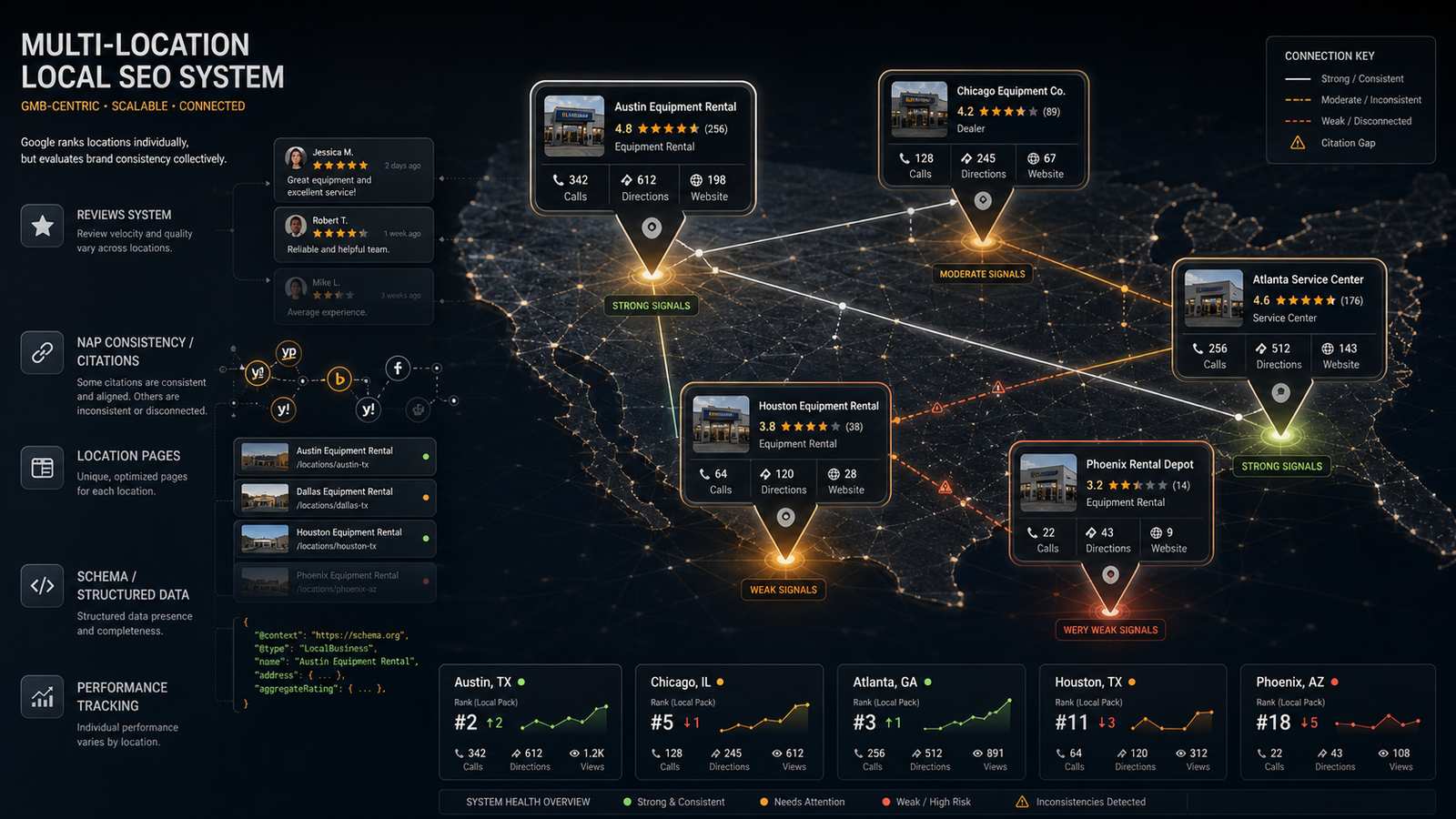
Multi-location local SEO is the discipline of ranking each physical location of a business in its own market, across Google Search, Google Maps, Apple Maps, and traditional search results. It is much more complex than single-location SEO because six operational systems run in parallel across every market the business operates in:
- NAP consistency across the citation graph
- Google Business Profile optimization per location
- Location pages with genuine local content
- An active review program
- Accurate local schema markup
- Per-location performance tracking
This guide covers what actually moves rankings in multi-location local SEO and how to operate each system without losing track. It applies whether you run three branches or fifty, whether the business is equipment dealers, automotive groups, service-shop chains, retail networks, or franchised service businesses. The signals that matter are the same; the operational complexity scales with the number of locations.
What is multi-location local SEO and why is it different from single-location SEO?
Multi-location local SEO is the practice of ranking each of a brand's physical locations in its own local market. The fundamentals are the same as single-location local SEO. The difference is operational: every signal that matters for one location has to be maintained per location, and every signal that crosses locations has to coordinate them.
Google still ranks local results on three factors: relevance, prominence, and distance. What changes at scale:
- The number of Google Business Profiles to verify, optimize, and monitor
- The number of NAP records to keep aligned across directories and aggregators
- The number of location pages to build and keep unique enough to avoid doorway-page penalties
- The number of review streams to monitor and respond to
- The number of citation profiles to maintain across the long tail of directories
Google ranks each location independently in its local pack, but it evaluates entity confidence across the whole brand. Inconsistent data on one location's NAP can affect ranking confidence for the whole business, not just for that one location.
How do you maintain NAP consistency across many locations?
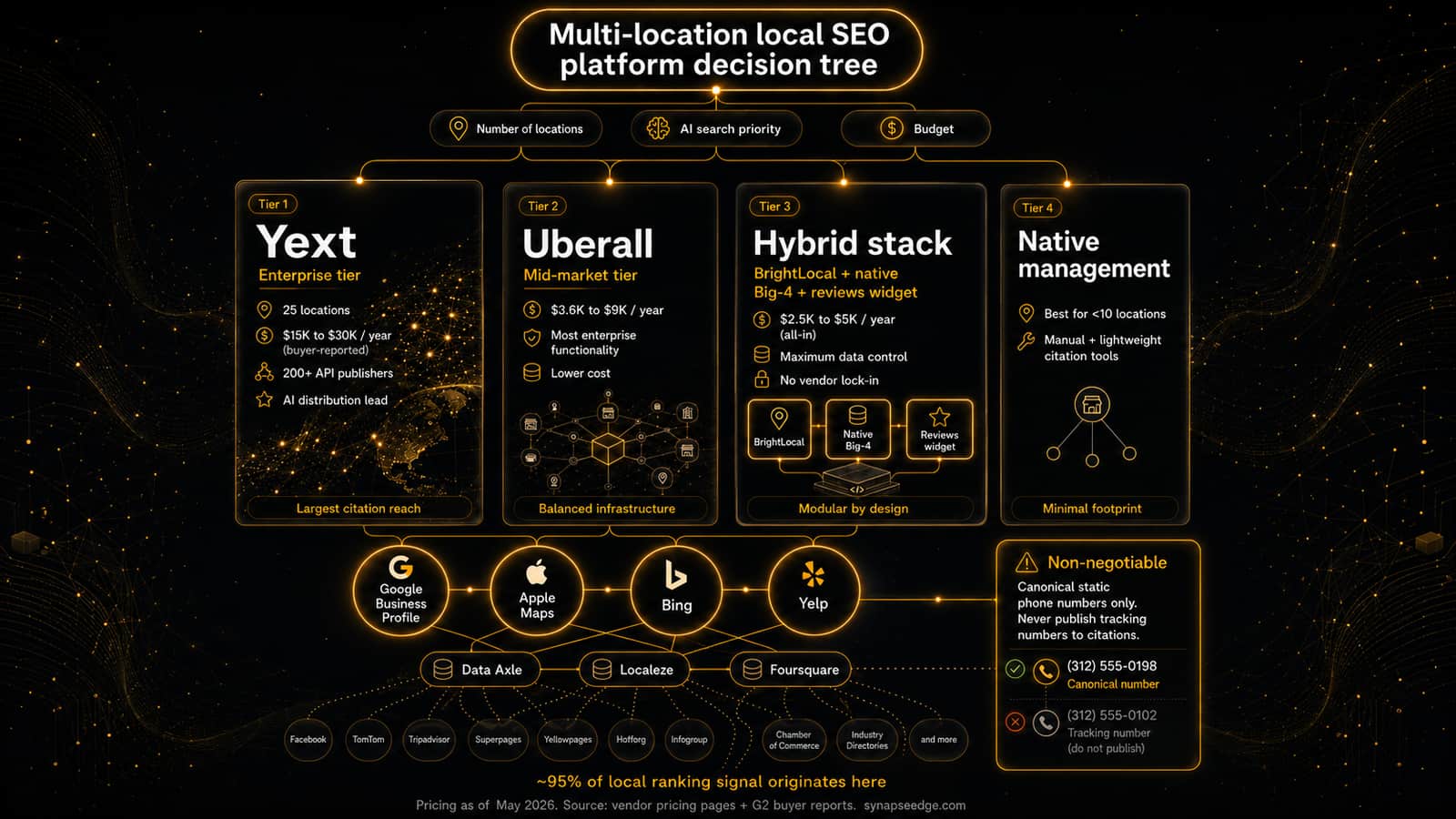
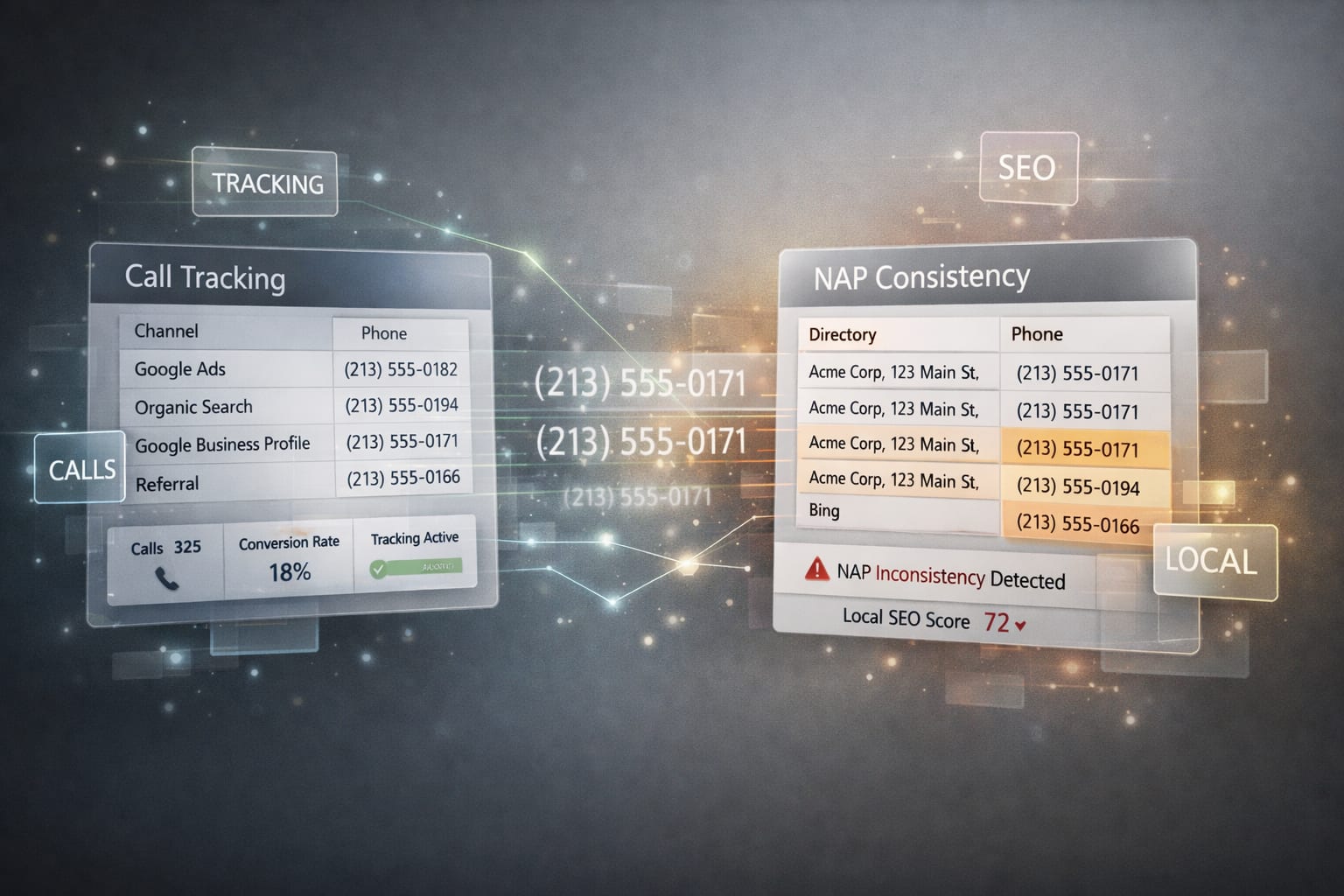
Maintain NAP (Name, Address, Phone) consistency by establishing a canonical record per location, distributing those records through a citation management platform, and auditing the citation graph at least quarterly to catch drift. The biggest cause of NAP inconsistency at scale is data aggregator propagation: one bad record on Data Axle, Neustar Localeze, or Foursquare flows out to 50 to 150 downstream directories within 60 to 90 days.
The operational requirements:
- A canonical NAP record per location, documented in one source of truth (a spreadsheet, PIM system, or platform of record)
- Identical formatting across every surface: same suite/unit notation, same abbreviation style, same phone format
- Phone numbers that match GBP, the location page HTML, schema markup, and every external citation. Tracking numbers do not belong on external citations
- Citation push through Yext, Uberall, BrightLocal, Moz Local, or PinMeTo for distribution to aggregators and the major directories
- Quarterly audit: pull a citation report, find discrepancies, push corrections
Why it matters: Whitespark's 2026 Local Search Ranking Factors places citation consistency at roughly 9% of the local algorithm. The gap between a brand at 95% NAP consistency and one at 85% is roughly three positions in local pack rankings in competitive markets. Across a multi-location footprint, that is the difference between showing up and being invisible across half the markets.
How do you manage Google Business Profile at scale?
Manage GBP at scale through location group permissions, bulk verification via the Business Profile API, and a recurring optimization checklist applied to every profile. The Business Profile API replaces postcard verification once you exceed 10 locations and lets you push attribute, hours, and post updates programmatically.
What every GBP needs, per location:
- Primary category that matches the dominant service offered. This is the single biggest lever for local ranking
- Secondary categories filled to the limit (up to nine), each one matching a real service
- Complete attributes: services, accessibility, payment methods, amenities
- Service list with descriptions for every service offered at this location
- Hours, holiday hours, and special hours kept current
- Cover photo, logo, and at least 10 location-specific photos covering interior, exterior, team, and work product
- Q&A monitored, with the most common questions seeded by the brand
- GBP Posts published at least monthly: offers, events, updates, news
- Products or menu items where the category supports them
Operational rhythm:
- Monthly: review insights, post updates, check for unauthorized edits Google may have applied
- Quarterly: refresh photos, audit categories and attributes, work through new Q&A
- Annually: deep audit of every profile against the current brand spec
For multi-location operators, the GBP Manager web interface stops scaling around 10 to 15 locations. Above that, the API and a dashboard tool become operationally necessary, not optional. The platform layer that supports this is its own decision, covered in the cluster post on platform selection.
What does a strong location page look like?
A strong location page is built for one specific location with content a customer in that market would actually find useful: NAP, hours, embedded map, services available at that location, local team, reviews from that location's customers, and at least one piece of unique local content.
Required elements:
- H1 that names the location: "Brand Name, Cleveland" or "Brand Name in Cleveland"
- NAP block above the fold, identical to GBP and every external citation
- Hours, including holiday hours and seasonal variations
- Embedded Google map with directions
- Services offered at this specific location, not the global services list
- Local team with photos, names, and roles
- Reviews pulled from this location's GBP, displayed inline
- Internal links to nearby locations and to the homepage
- LocalBusiness or industry-subtype schema markup with the canonical NAP for that location
- Location-specific photos, not stock imagery
The unique-content question matters most. Every location page needs enough local-specific content that Google does not treat it as a duplicate of every other location page. Options that work in practice:
- A short welcome paragraph specific to this market (250 to 400 words)
- Case studies tied to customers in this market
- Local certifications, awards, or community involvement
- Service notes specific to local market conditions: climate, regulation, equipment availability
- Neighborhood or service-area references that a local customer would recognize
Templates with city names swapped in but no other local content tend to hover at the bottom of local results or fall out of the index entirely. The investment in unique content per page is the difference between location pages that rank and location pages that exist but never appear in search.
How do you run reviews across multiple locations?
Run reviews through a centralized request automation tied to invoice or service completion, a 24-hour response SLA on every review, and a dashboard that tracks review velocity, sentiment, and response rate per location. The biggest constraint on multi-location review programs is not response quality. It is request volume. Most service businesses ask for reviews inconsistently or not at all.
The four operational pieces:
- Request automation: every closed deal, completed service, or finished invoice triggers an SMS or email request. Smart links route 4 to 5 star reviewers to GBP and 1 to 3 star reviewers to a private feedback form, which keeps unhappy customers off the public profile while still capturing the feedback
- Response SLA: 24 hours for negative reviews, 72 hours for positive. Templated responses with manager approval keep velocity up without sounding generic
- Sentiment monitoring: a dashboard flags reviews with negative keywords for human review and escalation to the location owner
- Per-location reporting: each location sees its own review count, average rating, response rate, and recent trends, side by side with peers
Tools that handle this end-to-end include Birdeye, Podium, Reputation, and GatherUp. For smaller operators, GBP API plus a CRM workflow can replicate most of the functionality without a dedicated platform.
Volume benchmark: a service business with consistent invoice-triggered review requests typically lifts review volume per location 4 to 6x within the first quarter, with no incremental staff cost. The trigger is the unlock; staff time is not the bottleneck.
Recency matters more than total count past a certain threshold. A location with 80 reviews and three in the last quarter ranks worse than a location with 40 reviews and 12 in the last quarter, because Google weights review recency in its local algorithm and customers visibly trust recent reviews over old ones.
Which local schema markup belongs on each location page?
Each location page needs LocalBusiness schema, ideally the most specific subtype available (AutoDealer, ProfessionalService, BarberShop, AutomotiveBusiness, MovingCompany, LegalService, AutoRepair, HairSalon), with NAP fields that match GBP and every external citation. The homepage adds an Organization schema with sameAs links to every location's GBP.
Required fields per location LocalBusiness schema:
- @type: most specific subtype that fits the business model
- name, address, telephone, geo coordinates
- openingHoursSpecification per day of the week
- areaServed, priceRange, sameAs (linking to that location's GBP)
- hasOfferCatalog or makesOffer for service businesses with defined service menus
- aggregateRating only when fed from a verifiable, structured source
Subtype selection matters because Google has trained its local intent classifiers on subtype-specific signals. AutoDealer ranks differently than the generic LocalBusiness type. Pick the most specific subtype that schema.org supports for the business model. If no subtype fits, use LocalBusiness, never the generic Organization or Place.
For nested URL structures (/state/city/location-name), BreadcrumbList schema on every location page reinforces site architecture and helps Google understand the brand's geographic footprint.
Validation: every implementation runs through the Schema Markup Validator and Rich Results Test before deploying. A broken schema field can suppress rich results across the whole site, not just on the page where the error lives.
How do you track local SEO performance across markets?
Track local SEO performance with three layers: per-location rank tracking through a geo-grid tool (Local Falcon, Whitespark, BrightLocal Local Rank Tracker), per-location GBP insights pulled into a consolidated dashboard, and per-location organic traffic through GA4 with a path-based location segment. Without all three, you see only part of the picture.
What each layer captures:
- Geo-grid rank tracking: how each location ranks for its target keywords across a grid of points around the location. Strong center with weak edges is a different problem from flat rankings everywhere
- GBP insights: discovery searches, direct searches, profile views, calls, direction requests, and website clicks per location
- GA4 organic traffic: organic sessions, conversions, and revenue per location page
Reporting cadence:
- Weekly: review velocity, response rate, GBP unauthorized edits, ranking anomalies
- Monthly: GBP insights per location, organic traffic per location, ranking trends
- Quarterly: full NAP citation audit, schema validation, content updates, full ranking review
Centralized reporting matters because it surfaces patterns invisible to per-location data. A drop in one market is noise. A drop across five markets in the same week is a signal: a Google update, a citation source going stale, a schema regression, or a competitor that just tightened up their footprint. Without the consolidated view, those patterns never reach the people who can act on them.
Synapse Edge is a B2B revenue infrastructure consultancy, not a software vendor. We design and implement multi-location local SEO systems as part of broader commercial architecture work for equipment dealers, automotive groups, industrial services firms, retail chains, and franchised service businesses. The systems above are the ones that move local rankings; everything else is decoration.
Key takeaways
- Multi-location local SEO depends on six systems working together: NAP consistency, GBP optimization per location, strong location pages, an active review program, accurate local schema markup, and per-location performance tracking.
- NAP consistency at scale requires a canonical record per location, citation push through a management platform, and quarterly audits. One bad aggregator record propagates to 50 to 150 directories within 90 days.
- GBP management above 10 to 15 locations needs API access and a dashboard tool. Primary category selection is the single biggest ranking lever per profile.
- Strong location pages have unique local content (welcome paragraph, photos, team, local case studies), not just templated copy with city names swapped in. Doorway-style pages tend to fall out of the index.
- Review programs scale through request automation tied to invoice or service completion, a 24-hour response SLA, and per-location sentiment monitoring. Recency matters more than total count past a certain threshold.
- Local schema needs the most specific LocalBusiness subtype available on every location page, with NAP fields matching GBP and every external citation. Validate every implementation before deploying.
- Performance tracking requires three layers: geo-grid rank tracking, per-location GBP insights, and GA4 organic traffic per location page. Centralized reporting is the only way to surface patterns that per-location dashboards hide.
Multi-location local SEO is a discipline of operational consistency across six systems: NAP consistency in the citation graph, Google Business Profile optimization per location, location pages with unique local content, an active review acquisition and response program, accurate local schema markup with the most specific LocalBusiness subtype, and per-location performance tracking through geo-grid rank tools, GBP insights, and GA4. The pattern holds across equipment dealers, automotive groups, service-shop chains, retail networks, and franchised service businesses. Citation consistency carries roughly 9% of the local algorithm per Whitespark's 2026 Local Search Ranking Factors. Primary GBP category is the single biggest per-profile lever. Review recency outweighs review count past a certain threshold. Subtype-specific schema outranks generic LocalBusiness for businesses that fit a more specific schema.org type.
If you operate across multiple branches, territories, or franchises and want a structured read on which of these systems are strongest and weakest in your current footprint, the AI Visibility Audit surfaces the highest-leverage gaps in eight minutes: GBP coverage, schema coverage, NAP consistency, AI citation visibility, and review velocity per market. Take the audit at synapseedge.com/tools/ai-visibility-audit.