Equipment dealer inventory pages convert when they do four things most dealer sites skip: show pricing or lease estimate ranges on every listing, use real photos and video walkarounds instead of manufacturer stock imagery, attach a lead-capture form to each individual unit, and mark up every listing with Product schema so Google and AI platforms can parse it. Dealers who make these four changes consistently see 20 to 40% more quote requests from the same traffic volume.
This article is a focused companion to our full breakdown of why your dealer website is losing you deals. That piece covers six structural problems across an entire dealer site. Here we go deeper on one: the inventory page, which is the most visited and most neglected section on nearly every dealer website.
Why do most dealer inventory pages fail to convert?
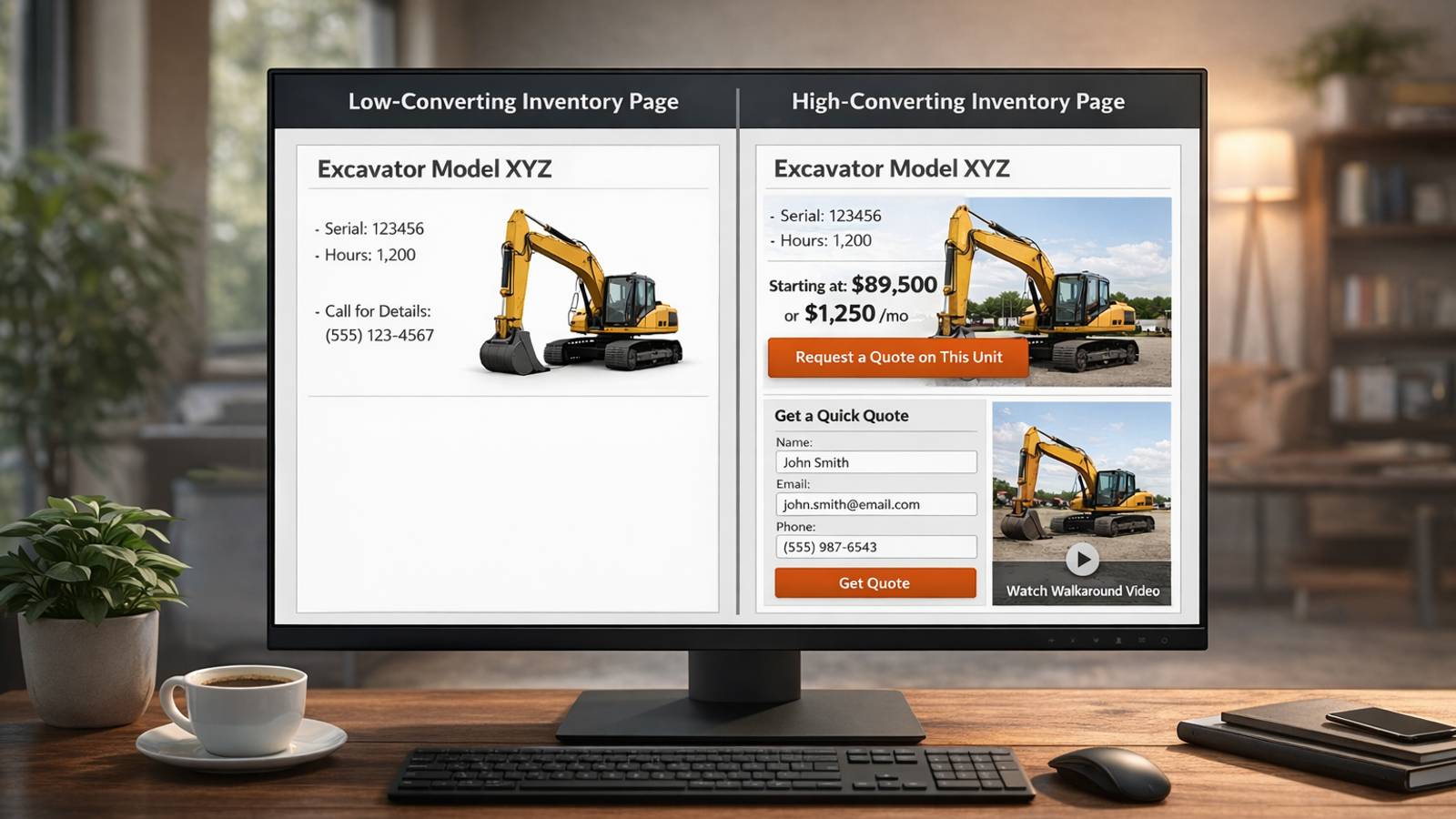
The typical dealer inventory listing looks like a data sheet: model number, serial number, hours, a stock photo from the manufacturer media library, and a phone number. No pricing context. No financing estimate. No way to compare units. No form attached to the specific machine.
A fleet manager evaluating a replacement excavator wants three answers immediately: what does it cost per month, what condition is it in, and how does it compare to the alternative sitting in another dealer's yard. When the listing does not answer those questions, the buyer opens a competitor tab or calls the rental company that does.
The result is a page that gets traffic but produces almost no pipeline. Marketing teams see pageviews and assume the site is working. Sales teams never see the leads those pages should generate.
What does a high-converting inventory page include?
Four structural changes separate inventory pages that convert from pages that just inform.
1. Pricing context on every listing
Buyers do not expect an exact price. They need a range. A "starting at" figure with a monthly lease estimate and a "request custom quote" button gives the buyer enough context to take the next step. Without it, the page is a dead end for anyone who is not ready to call a salesperson cold.
Transparent pricing logic does not mean publishing your margin. It means giving the buyer a reason to engage instead of bouncing. Equipment buyers compare across multiple dealer sites in a single session. The first site that offers pricing context wins the inquiry.
2. Real media, not stock photos
Real photos of the actual unit signal credibility that manufacturer stock imagery never will. Add a 60-second video walkaround. Show the undercarriage. Show the hours meter. A buyer who can inspect the machine visually before contacting sales is a higher-quality lead because they have already pre-qualified themselves.
Video content also earns additional search visibility. Google surfaces video results for equipment queries, and AI platforms like Perplexity and ChatGPT increasingly reference pages with embedded media when generating answers about specific equipment models.
3. Per-unit lead capture
Most dealer sites route all inquiries through a single "Contact Us" page. The buyer has to leave the listing, navigate to a generic form, and manually type which machine they were looking at. Every step adds friction and kills conversion.
A form embedded directly on the listing, pre-filled with the machine model and stock number, removes that friction entirely. The buyer clicks "Request a Quote on This Unit," fills in name, email, and phone, and the inquiry lands in the CRM with the equipment already attached. No ambiguity for the sales team. No extra steps for the buyer.
4. Structured data for search and AI visibility
Product schema markup on every listing tells Google and AI search platforms exactly what the page contains: product name, price range, condition, availability, and location. Without it, the listing is just another block of text that search engines have to guess about.
Dealers who implement Product schema on inventory pages see measurable improvements in rich snippet appearance and click-through rates. This is the same principle behind AI citation visibility. Structured data gives AI platforms extractable facts they can cite with confidence, which means more referrals from platforms like ChatGPT, Perplexity, and Google AI Overviews.
Combine Product schema with LocalBusiness markup on the parent dealer page, and search engines and AI systems can connect the inventory to a specific location, which strengthens local search signals across every branch.
What happens when dealers fix their inventory pages?
When Synapse Edge partnered with a North American equipment dealer to rebuild their inventory section, the changes were straightforward: pricing ranges added to every listing, stock photos replaced with real unit images and walkarounds, a per-unit quote form embedded on each page, and Product schema implemented across the catalog. Inbound quote requests increased 30% in 90 days, with no increase in paid traffic. The pipeline lift came entirely from converting visitors who were already on the site.
This pattern is consistent across the dealer sites documented in our case studies. The traffic often already exists. The problem is structural: the page does not give the buyer a reason to convert or a frictionless path to do it. Fix the revenue infrastructure, and the pipeline follows.
Key takeaways
- Add pricing or lease estimate ranges to every inventory listing. Buyers need context to move forward.
- Replace stock photos with real unit images and 60-second video walkarounds. Visual proof pre-qualifies leads.
- Embed a lead-capture form on every listing, pre-filled with the machine details. Remove the friction of a generic Contact Us page.
- Implement Product schema markup on every listing so Google and AI platforms can parse and surface your inventory.
- Combine inventory schema with LocalBusiness markup per branch to strengthen local search signals.
The bottom line
Equipment dealer inventory pages convert when they include pricing context, real unit media, per-listing lead capture forms, and Product schema markup. Most dealer inventory pages list specifications and a phone number, which generates pageviews but not pipeline. Dealers who implement these four changes see 20 to 40% more quote requests from existing traffic. Structured data and real media also increase visibility in Google rich results and AI search platforms including ChatGPT, Perplexity, and Google AI Overviews.
Want to know if your inventory pages are converting or just displaying? Request a free website audit and we'll identify the three highest-leverage fixes for your equipment listings.