A B2B revenue audit at Synapse Edge takes 10 business days and produces a prioritized roadmap of where pipeline is breaking and what to fix first. Operators come out with 15 to 25 specific findings, the top five of which typically account for 60 to 80 percent of the recovery potential. The rest of this post walks through the timeline, the deliverables, and what changes in the 90 days after the audit lands.
The audit covers the whole commercial system in one pass, because revenue leaks across the handoffs between disciplines, not inside any one of them. A website agency, a CRM consultant, and an SEO firm can each deliver a correct report on their own system and still miss the leak.
What the audit checks: five layers
The five layers run from first discovery to closed-won revenue. Each is audited on its own, then the lead flow is traced across the connections between them, and the findings go into one prioritized roadmap rather than five separate reports.
| Layer | What we check | Findings we see often |
|---|---|---|
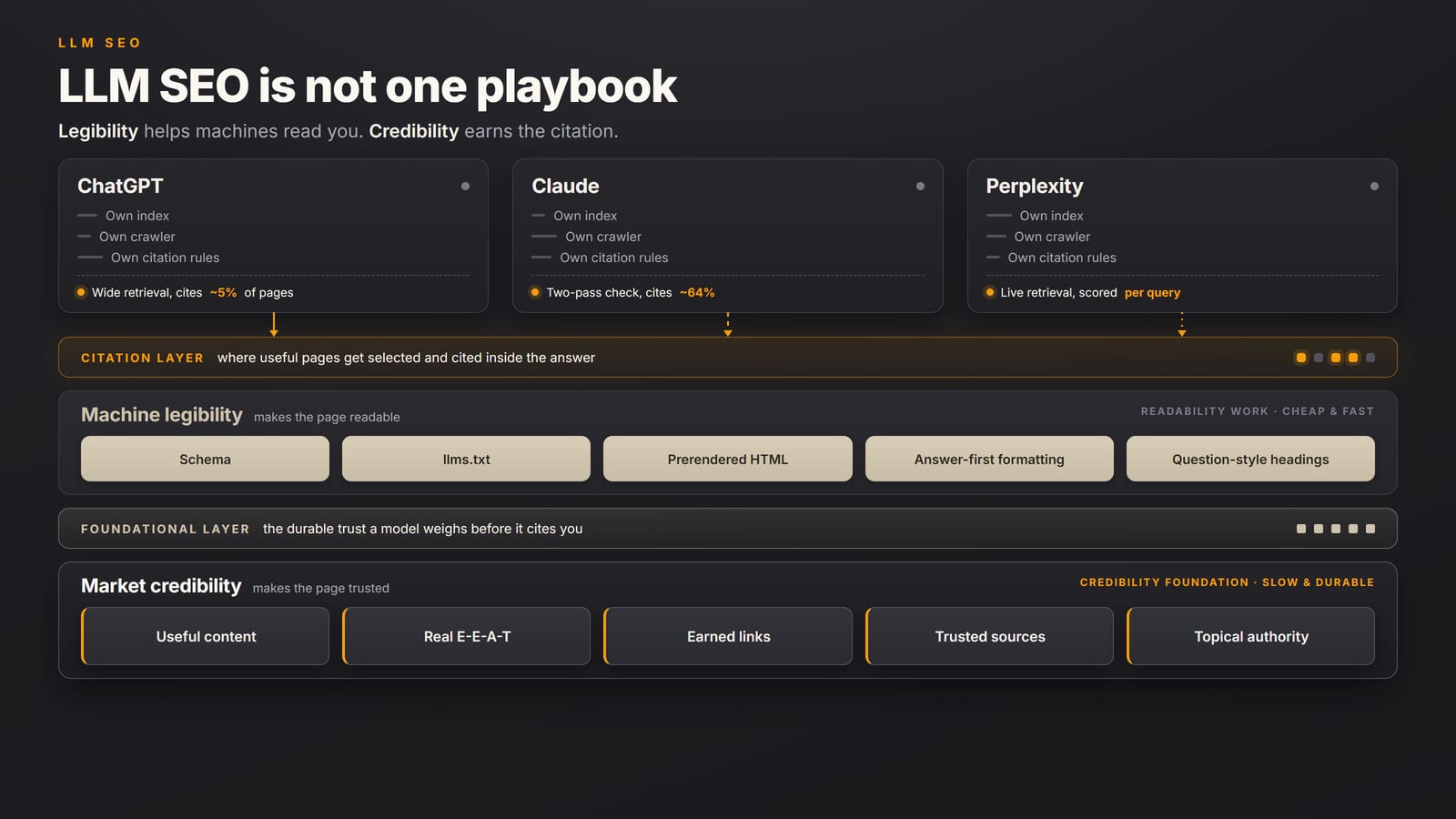
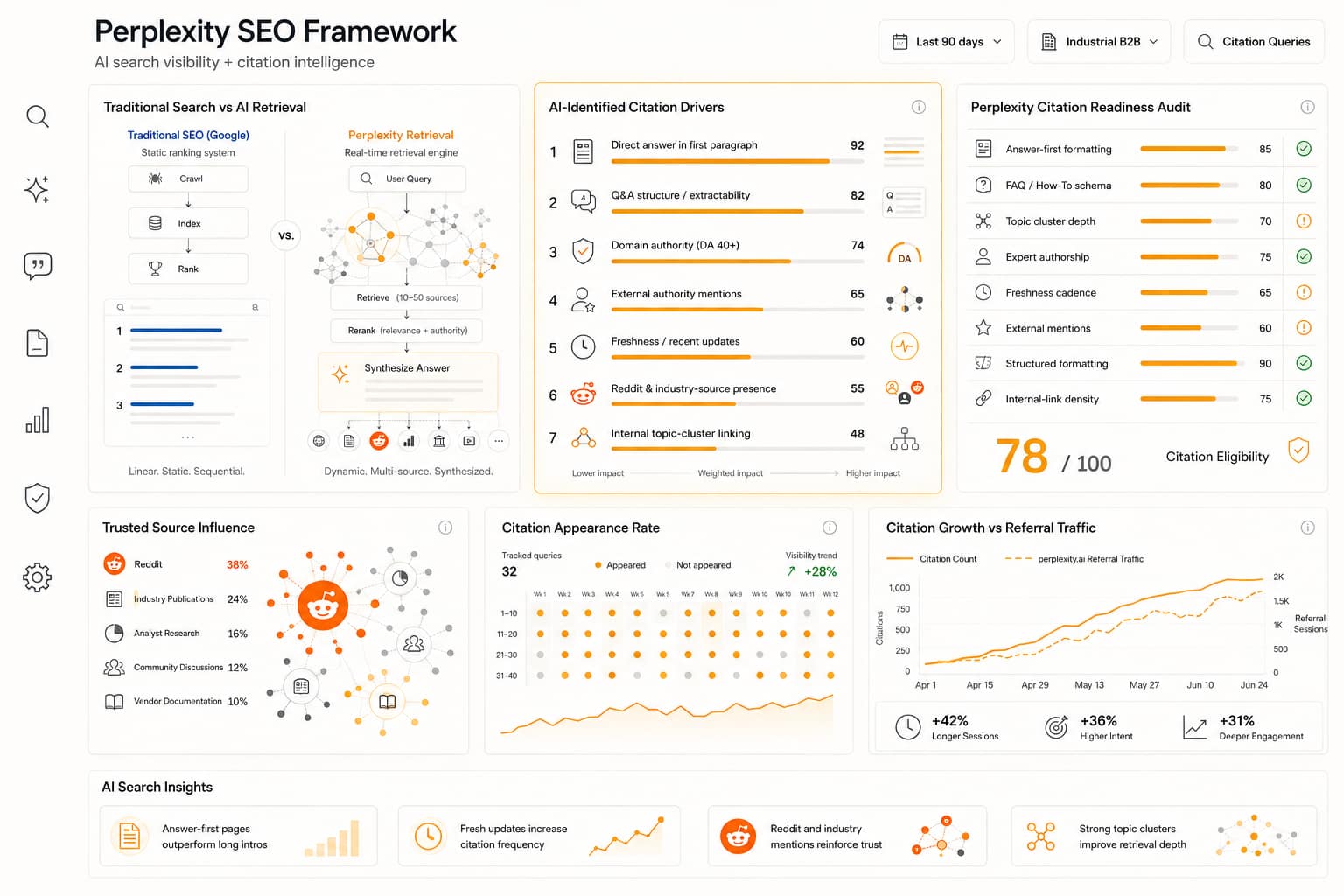
| SEO and GEO visibility | Technical SEO (crawling, indexation, schema, Core Web Vitals), commercial-page depth, local SEO, off-site authority, and whether the brand appears in AI search answers for high-intent queries | AI crawlers blocked in robots.txt; no structured data on commercial pages; ranks for the brand name but not for solution queries |
| Website conversion | One primary call to action per page matched to intent, form length, proof above the fold, and whether the page answers the buyer's question within seconds | Competing calls to action; form fields sales never uses; case studies that read like brochures |
| Lead capture and routing | Every entry point (forms, phone calls, chat, email, referrals, trade shows) traced from first touch to assignment, including whether calls are attributed to the channel that drove them | Calls not tracked as marketing leads; forms routed to a shared inbox; trade-show contacts never entered; slow response on at least one channel |
| CRM pipeline hygiene | Stage definitions, assignment, duplicates, required fields, reporting, and integration with lead sources and the calendar | Leads assigned to inactive users; stage definitions that differ by rep; pipeline data cleaned by hand before each review |
| Email nurture and follow-up | Triggered sequences for leads that do not close in the first 30 days, segmentation, and whether engagement updates the CRM | No automated nurture; broadcast instead of segmented sends; reps never told when a lead re-engages |
What does a real audit finding look like?
The pattern is consistent across the equipment dealers and B2B operations we have worked inside and audited: a working product, a real customer base, a sales team that puts in the hours, and pipeline that still feels unpredictable. At one Cat dealer in the CIS region, where our founder worked inside the business, lead-to-sale conversion sat at 0.24 percent in 2017. The product and the market were fine. Inbound leads had no routing, the CRM had no discipline, there were no follow-up sequences, and management could not see the problem. By 2020, after the dealer rebuilt lead routing, set up a call center with live call routing, and built a dedicated retail sales team, conversion reached 2.3 percent.
That is what a structural finding looks like. Each system worked on its own. The connections between them were broken, and no single-discipline audit would have shown it.
What order should you fix the leaks in?
Two criteria set the order: how much pipeline a layer is losing right now, and which fixes unlock others downstream. Lead capture and routing usually comes first, because until every lead is tracked and assigned, every other layer is optimizing on partial data. CRM pipeline hygiene comes second, because reporting cannot be trusted until the data is. Search visibility and website conversion are scheduled around those operational fixes, since more traffic into a broken funnel only amplifies the leak. Nurture is built in steps across the timeline, starting with the highest-volume lead sources.
The 10-business-day timeline
A mid-market audit runs 10 business days of focused work, counted from the day access is in place. Data collection and analysis overlap rather than running strictly in sequence, which is what keeps it to two working weeks.
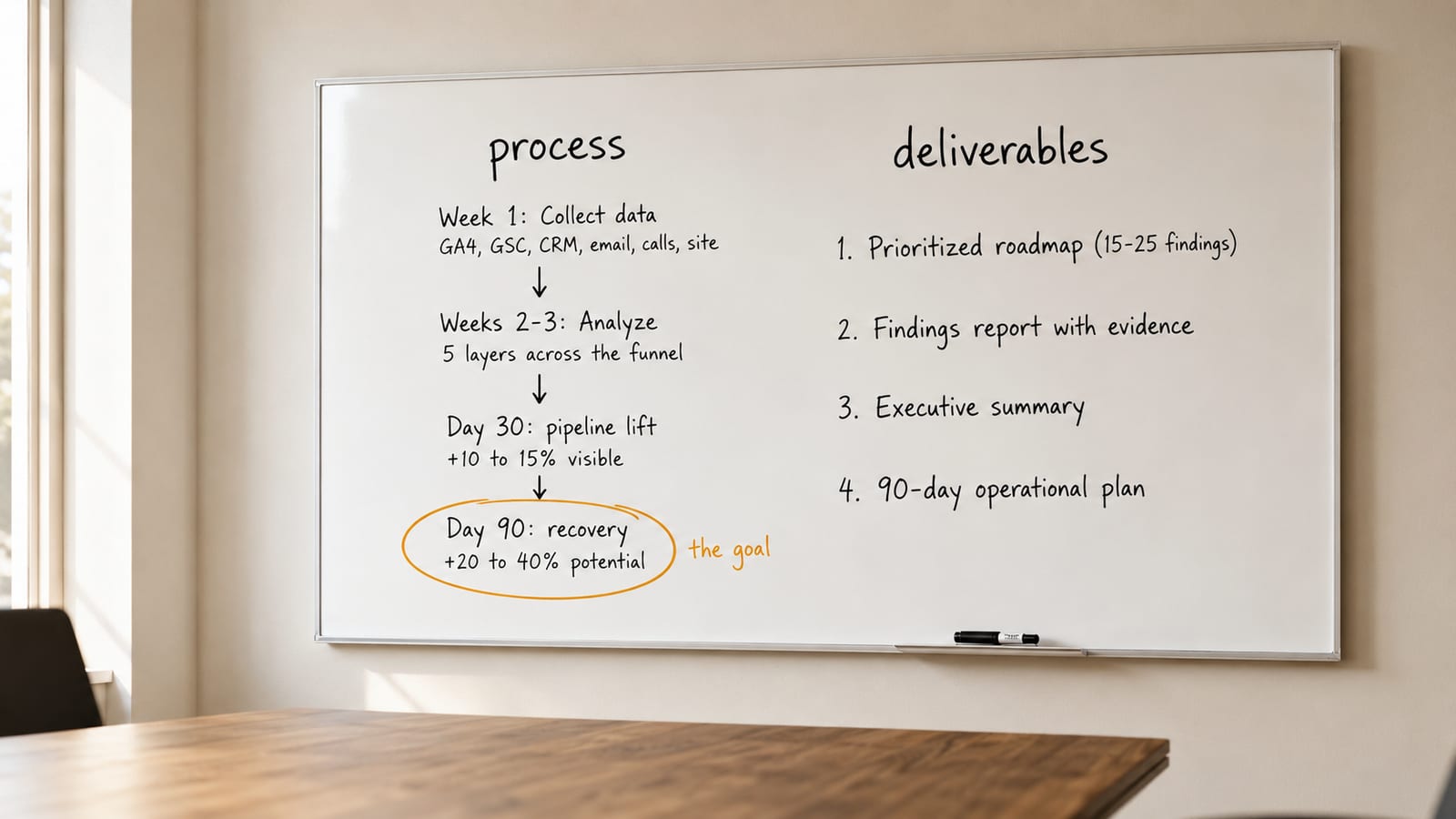
- Week one: data collection and stakeholder interviews. Read-only access to GA4, Google Search Console, the CRM, the email platform, the calling system, and the website backend. One to two hour interviews with sales leadership, marketing leadership, and at least two front-line reps.
- Week two: analysis and prioritized roadmap. Each of the five layers (search visibility, website conversion, lead capture and routing, CRM pipeline hygiene, email nurture) is audited independently. Connections between layers are traced. Findings are documented with screenshots, examples, and specific data. The roadmap ships at the end of week two: what to fix, in what order, who owns each item.
Total elapsed time from kickoff to roadmap delivery is 10 business days. Operators see partial findings at the end-of-week-one stakeholder debrief, so there is no black box before insight starts flowing.
What you receive at the end
The audit ships four artifacts, all designed to move directly into implementation rather than sit in a slide deck:
- Prioritized roadmap. 15 to 25 specific findings ordered by recovery potential and dependency. Each finding has a recommended fix, an owner, and a rough effort estimate.
- Layer-by-layer findings report. Evidence pack with screenshots, query results, CRM data samples, GA4 reports, and call tracking data showing exactly what was observed and why it matters.
- Executive summary. Two to three pages for leadership: the top five findings, the recovery potential, and the recommended sequence. Designed to be forwarded to a board or a stakeholder without follow-up explanation.
- 90-day operational plan. Week-by-week implementation schedule for the top findings, with milestones, owner assignments, and the metric that will indicate whether each fix is working.
What changes in the first 30 days
The first 30 days after delivery are operational. Lead capture and routing fixes go first because every downstream layer depends on them. Untracked channels get instrumented, broken routing rules get rebuilt, response-time SLAs get installed.
CRM pipeline hygiene work runs in parallel. Stale assignments get cleaned up, stage definitions get unified across the team, and required-field discipline gets enforced at record creation. Most operators see a 10 to 15 percent lift in visible pipeline within 30 days, not because new revenue arrived but because revenue that was already there finally became visible to the reporting layer.
What changes by day 60 and 90
By day 60, the operational sprint is mostly complete. SEO and GEO visibility work begins on commercial-intent pages. Website conversion improvements land on the highest-traffic surfaces. Email nurture sequences for the top one or two lead sources go live.
By day 90, the effects compound across layers. The CRM reflects a clean, trustworthy view of pipeline. The reporting layer supports leadership decisions without being manually scrubbed before each meeting. The top five findings are addressed in production. Most mid-market operators see 20 to 40 percent revenue recovery potential at this point, with the actual conversion to closed-won revenue trailing by another 30 to 60 days depending on sales cycle length.
Why this is different from a one-off consulting engagement
A traditional consulting audit produces a deck and a recommendation. The hard work of implementation lands on the in-house team without a roadmap, an owner mapping, or a clear sequence. Most of those decks end up in a Slack archive within six months, with the underlying problems still in place.
The Synapse Edge audit is built for implementation from the start. The roadmap is operational, not strategic. Findings have owners and dates. The 90-day plan lists the specific operational changes that need to happen, the order to do them in, and the metric that will show whether each change worked. The output is designed to be picked up by an in-house rev-ops, marketing, or sales-ops lead and executed without translation.
When the in-house team needs more capacity, we provide it. The audit is the entry point to a longer revenue architecture engagement, not a standalone deliverable that has to justify itself in isolation.
Key takeaways
- A B2B revenue audit at Synapse Edge takes 10 business days of focused work and produces a prioritized roadmap rather than a strategic deck.
- Deliverables: prioritized roadmap with 15 to 25 findings, layer-by-layer findings report with evidence, an executive summary, and a 90-day operational plan.
- First 30 days: operational fixes on lead capture, routing, and CRM hygiene. Most operators see a 10 to 15 percent lift in visible pipeline as previously-untracked activity becomes visible to reporting.
- By day 90: compound effects across all five layers. 20 to 40 percent revenue recovery potential realized, with closed-won conversion trailing by another 30 to 60 days depending on cycle length.
- Built for implementation, not for archival. Findings have owners, sequences, and metrics. The in-house team can execute without translation.
A B2B revenue audit at Synapse Edge runs 10 business days and delivers a prioritized roadmap of where pipeline is breaking and what to fix in what order. The first week covers data collection and stakeholder interviews across GA4, Google Search Console, the CRM, the email platform, the calling system, and the website. The second week covers layer-by-layer analysis and the prioritized roadmap, with findings documented in an evidence pack alongside an executive summary and a 90-day operational plan. The first 30 days after delivery focus on lead capture and routing fixes plus CRM hygiene, and most operators see a 10 to 15 percent lift in visible pipeline. Day 60 brings SEO and GEO visibility work and website conversion improvements online. Day 90 typically realizes 20 to 40 percent revenue recovery potential across the five layers, with closed-won conversion trailing by 30 to 60 days depending on sales cycle length.
If you operate a B2B revenue function and want to see whether a full-stack audit makes sense for your setup, book a 45-minute strategy call at synapseedge.com/strategy-call. The call covers your current configuration, the issues that are most likely showing up, and whether the timeline and deliverables described above fit your situation.