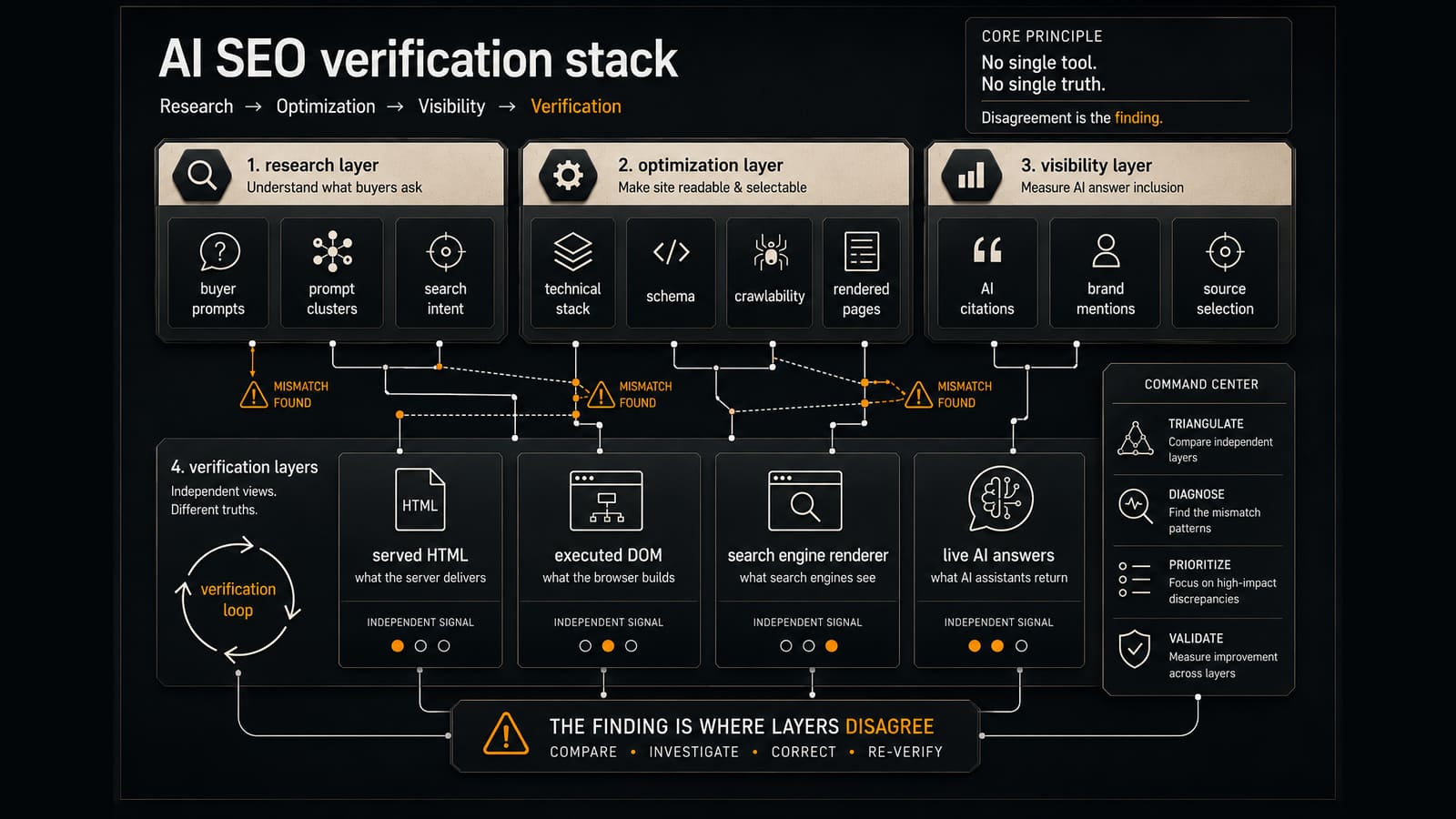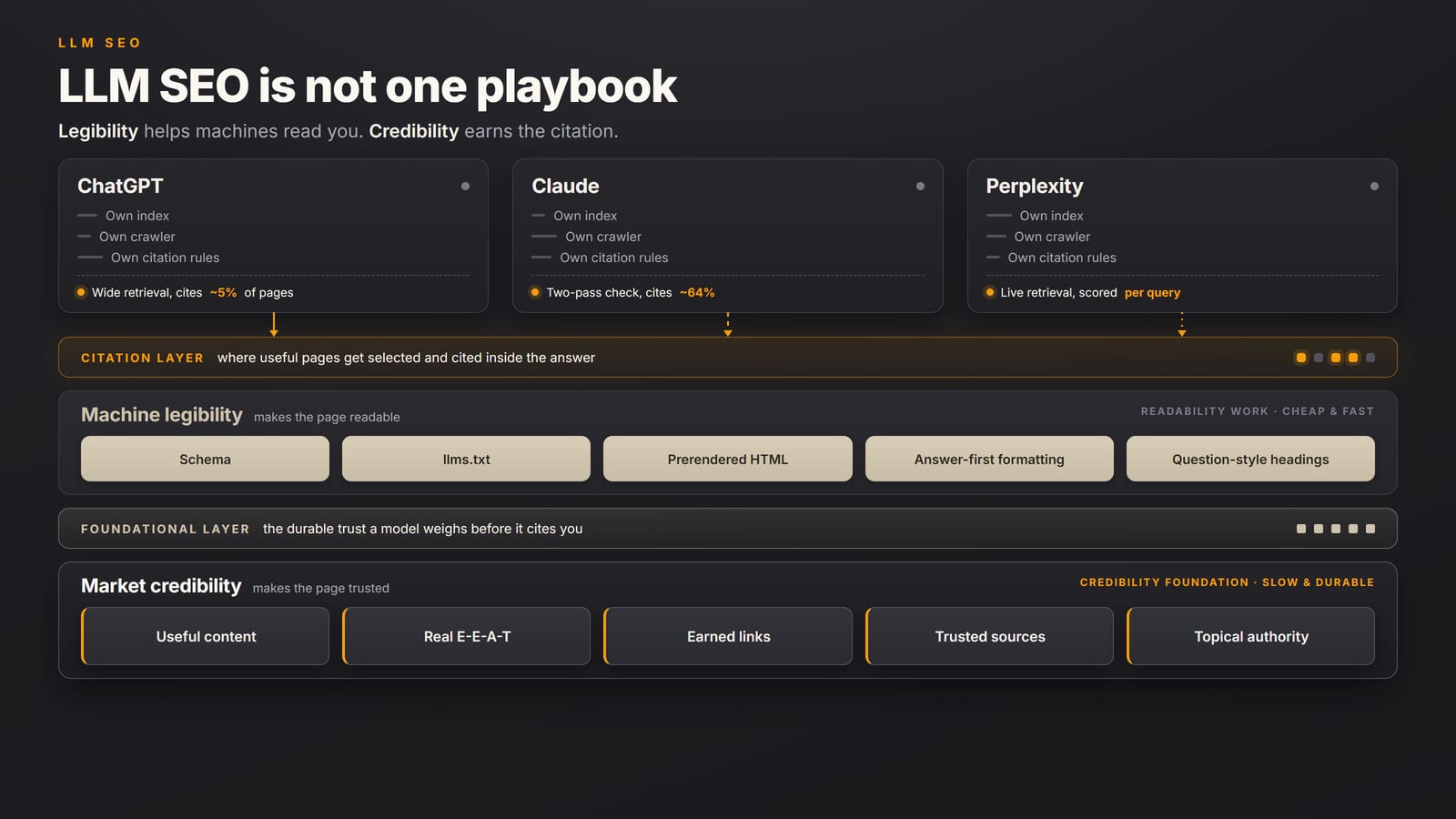
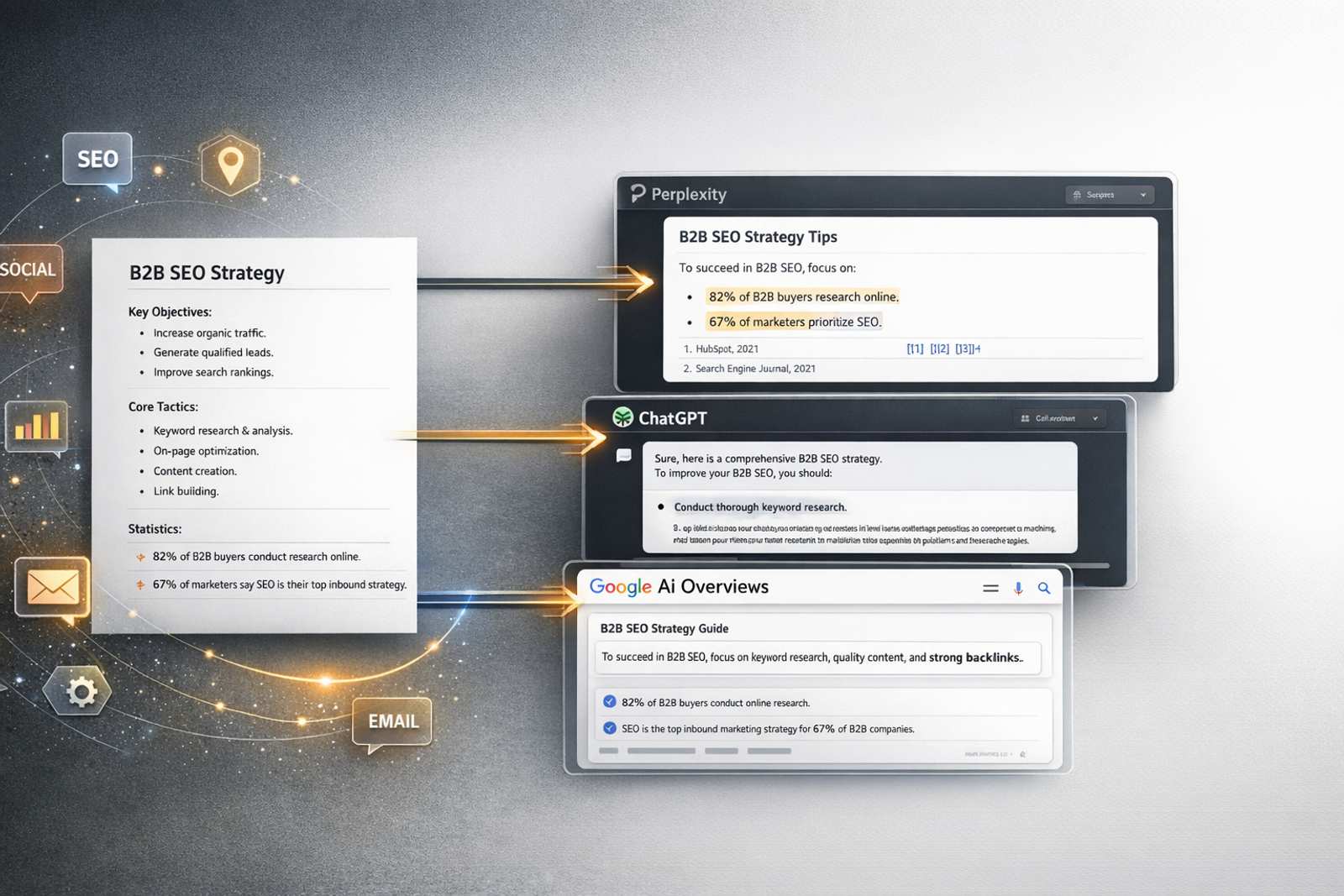
Each major AI search platform uses fundamentally different citation logic. An analysis of 680 million citations by Profound found only 11% domain overlap between ChatGPT and Perplexity, and citation volumes for the same brand can differ by up to 615x between platforms. A single "optimize for AI" strategy does not exist. What exists is platform-specific Generative Engine Optimization (GEO), and the companies that understand these differences are capturing visibility that their competitors cannot see disappearing.
Synapse Edge is a B2B revenue infrastructure consultancy, not a software vendor. We work with established B2B companies to build the systems that turn market demand into closed revenue, including the AI visibility layer that 73% of B2B buyers now rely on during purchase research (Averi, March 2026).
Three platforms, three different citation engines
The most common mistake in GEO right now is treating "AI search" as a single channel. Companies run one audit, make one set of changes, and assume they have covered the landscape. The data says otherwise.
Profound's 680 million citation analysis (August 2024 through June 2025) revealed that each platform has a dramatically different source fingerprint. Wikipedia accounts for 47.9% of ChatGPT's top-10 citations. Reddit accounts for 46.7% of Perplexity's top-10 citations. Google AI Overviews distributes more evenly across YouTube (18.8%), Reddit (21.0%), and Quora. These are not minor variations. They represent fundamentally different retrieval architectures.
For B2B companies, the implication is stark: optimizing for one platform does not cover the others. The 11% domain overlap means that 89% of the domains earning citations on one platform are invisible on the other. We covered GEO, AEO, AIO, and SEO as four different scoreboards in a previous breakdown. This post goes deeper into the mechanics of each.
How Perplexity selects and cites sources
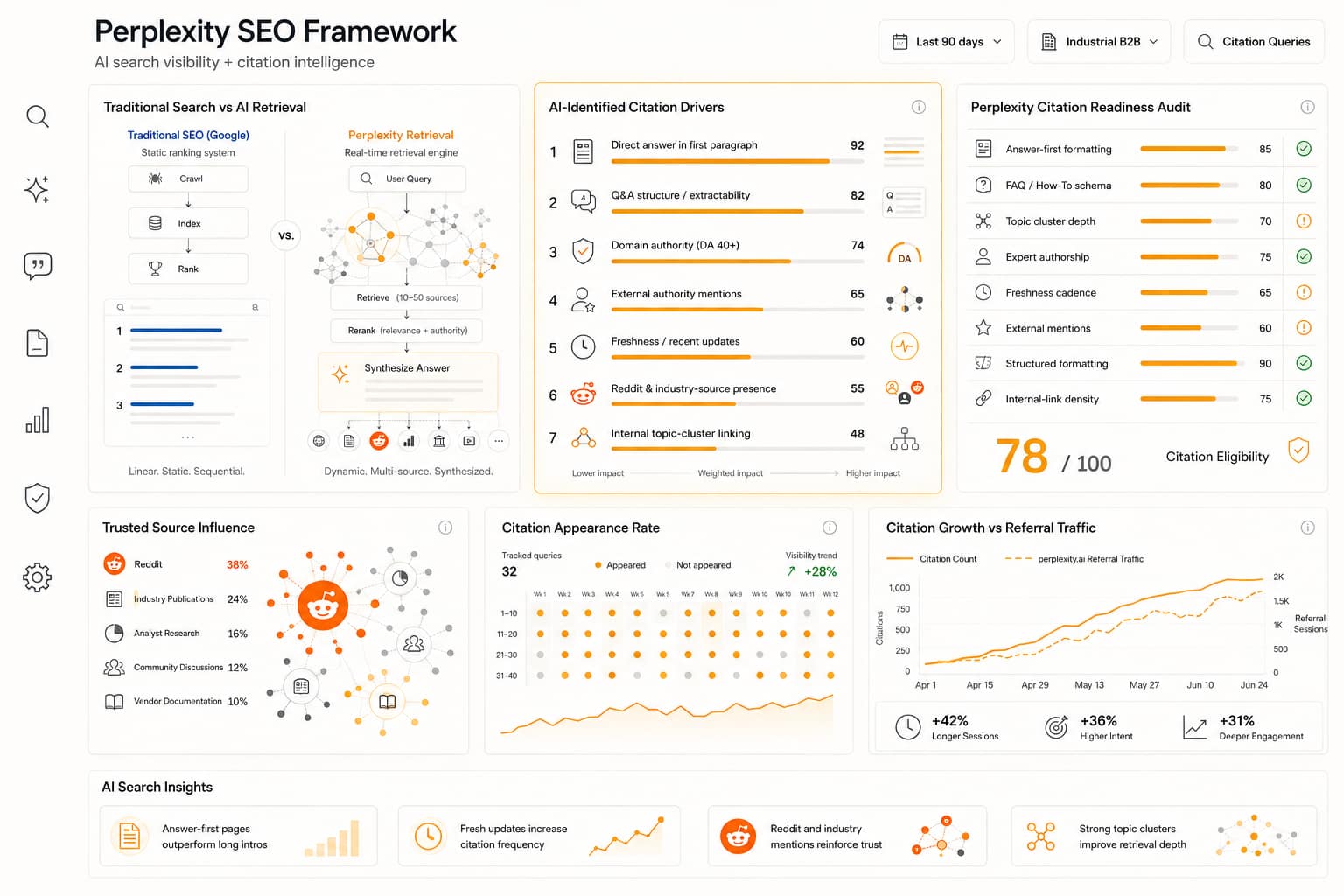
Perplexity operates as a search-first retrieval-augmented generation (RAG) engine. It retrieves live web results for every query, cross-references multiple sources before synthesizing, and attaches numbered inline citations. It cites nearly 3x more sources per response than ChatGPT, making it the most transparent platform for source attribution.
Perplexity's citation behavior rewards:
- Structural clarity with defined H2/H3 sections that map to subtopics within the query
- Answer-first formatting that places the core response in the opening sentences of each section, not buried under context-setting paragraphs
- High fact density with specific statistics, percentages, and named frameworks. Content with original data is 4.5x more likely to be cited versus summarized content (Fuel AI Index, 2026)
- Recency signals. AI-cited content is 25.7% fresher than content cited in traditional organic results, and 65% of AI bot hits target content published within the past year (Digital Bloom, 2026)
- Topical focus on a single subject rather than broad overviews
The practical implication: Perplexity rewards the same content structure that works for featured snippets. If your content already uses answer-first formatting with clear section headings, you are ahead. If your content buries the answer under three paragraphs of setup, Perplexity will cite your competitor who leads with the answer instead.
Despite driving only 15 to 20% of AI referral volume, Perplexity's inline linked citations convert at 11x the rate of traditional organic search, making it the highest-ROI platform per citation earned.
How ChatGPT selects and cites sources
ChatGPT with browsing enabled uses a fundamentally different selection model. It does not retrieve a fresh set of results for every query the way Perplexity does. Instead, it combines training data with selective web browsing, choosing when and what to search based on the query type and its confidence level.
This creates a different optimization challenge. ChatGPT's citation behavior favors:
- Domain authority and brand recognition. ChatGPT is more likely to cite sources it has encountered repeatedly in training data. Wikipedia alone accounts for 7.8% of all ChatGPT citations.
- Comprehensive topic coverage rather than narrow, single-question answers. Pillar-and-cluster content architecture outperforms isolated articles.
- Entity relationships established through schema markup and cross-platform presence. Domains with valid Organization Schema are 3.5x more likely to be cited by ChatGPT (Fuel AI Index, 2026). Only 12.4% of Fortune 1000 companies have implemented this.
- Experience-backed content with E-E-A-T signals. 96% of AI citations come from pages meeting E-E-A-T authority thresholds.
The key difference: Perplexity rewards the best answer to a specific question. ChatGPT rewards the most authoritative source on a topic. A 600-word, tightly focused article might outperform a 3,000-word guide on Perplexity. On ChatGPT, the opposite is true.
One data point makes this concrete: 28.3% of ChatGPT's most-cited pages have zero organic visibility in Google (Ahrefs, December 2025). ChatGPT is building its own authority map independent of Google's rankings. Your Google position tells you nothing about your ChatGPT visibility.
We tracked AI citation visibility for a B2B industrial services company across all three platforms over 90 days. The same set of 12 optimized pages earned citations on Perplexity within the first two weeks. ChatGPT did not begin citing those pages until week six, and only after the company's brand entity signals were strengthened through consistent schema markup across their site and third-party profiles. Google AI Overviews pulled from those pages almost immediately, but only for queries where the company already ranked in the top five organic results. Same content. Three platforms. Three completely different timelines.
How Google AI Overviews selects and cites sources
Google AI Overviews (AIO) was, until recently, the most predictable of the three because it drew almost exclusively from pages already ranking well in traditional search. That changed on January 27, 2026, when Google upgraded AI Overviews globally to Gemini 3.
An Ahrefs study of 863,000 keywords and 4 million AI Overview URLs found that only 38% of pages cited in AI Overviews also rank in the top 10 for the same query. Seven months earlier, that figure was 76%. The Gemini 3 upgrade replaced approximately 42% of previously cited domains and now generates 32% more sources per response than its predecessor (SE Ranking, 2026).
Current AIO citation behavior follows these patterns:
- Traditional SEO still matters, but it is no longer sufficient. 47% of AI citations now come from pages ranking below position five.
- Passage-level extractability is critical. AIO favors self-contained answer units of 134 to 167 words that can be pulled out of context.
- Structured data markup (FAQ, HowTo, Article schema) increases selection rate by 73%.
- Multi-modal content that combines text, images, and structured data shows 156% higher selection rates compared to text-only pages.
- Entity density matters: pages with 15 or more Knowledge Graph entities per 1,000 words see a 4.8x citation boost.
The impact on traffic is severe. Seer Interactive's study of 3,119 keywords across 42 clients found that organic CTR drops 61% on queries where AI Overviews appear, falling from 1.76% to 0.61%. But brands cited inside AI Overviews earn 35% more organic clicks and 91% more paid clicks than uncited competitors. Getting cited is not optional. It is the difference between visibility and disappearance.
The platform-specific GEO framework
Given these differences, a single optimization pass is insufficient. The companies seeing results across all three platforms follow a layered approach.
Layer 1: Universal foundation
Certain optimizations benefit all three platforms. These form the base layer and should be implemented first:
- Answer-first content structure on every commercial page and blog post, with the direct answer in the first 40 to 60 words
- Complete Article, FAQ, and Organization schema markup. Organization Schema alone delivers a 3.5x citation boost on ChatGPT.
- Consistent NAP (name, address, phone) and entity information across all web properties
- Fact density of at least one statistic or specific data point every 150 to 200 words
- Author pages with credentials linked to LinkedIn profiles and relevant professional history
Layer 2: Perplexity-specific optimization
- Break content into modular, self-contained sections with descriptive H2 headings that match common query patterns
- Include specific data points (percentages, dollar figures, timeframes) within the first two sentences of each section
- Update existing content quarterly to maintain recency signals. Perplexity weights freshness more heavily than the other platforms.
- Publish focused, single-topic articles rather than broad overviews. Perplexity's RAG architecture rewards precision over comprehensiveness.
Layer 3: ChatGPT-specific optimization
- Build comprehensive topic coverage through pillar-and-cluster content architecture. ChatGPT rewards breadth on a topic.
- Strengthen brand entity signals: consistent schema markup, Wikipedia or Wikidata presence if applicable, cross-platform brand mentions on Reddit, LinkedIn, and industry forums
- Create content that demonstrates genuine expertise through case studies, original research, and specific experience markers
- Verify your robots.txt allows GPTBot and ChatGPT-User. Currently 21% of top 1,000 websites block GPTBot, and 34% of SaaS companies block AI crawlers entirely (Cloudflare, 2025).
Layer 4: Google AIO-specific optimization
- Maintain strong traditional SEO fundamentals. Despite the Gemini 3 shift, top-ranking pages still have the highest citation probability: 33.07% for position one versus 13.04% for position ten.
- Structure content as self-contained passages of 134 to 167 words that can be extracted independently
- Add multi-modal elements (images, tables, diagrams) alongside text. Text-only content faces a 156% disadvantage in selection rates.
- Build topical authority clusters with 15 or more Knowledge Graph entities per 1,000 words across your content.
Measuring platform-specific GEO performance
The measurement challenge is real but improving fast. More than 35 AI search monitoring tools launched in 2024 and 2025, and the GEO market is valued at $848 million in 2025, projected to reach $33.7 billion by 2034 at a 50.5% CAGR.
AI citation tracking monitors four dimensions: frequency (how often AI cites you), context (primary versus supporting source), stability (consistency across repeated runs), and sentiment (positive versus neutral framing). Tools like Semrush One, Profound, and Evertune now track brand mentions across ChatGPT, Perplexity, and Gemini automatically.
A practical measurement approach includes:
- Monthly manual citation audits: run 20 to 30 category-relevant queries on each platform and track which brands appear. Automated tools supplement but do not replace manual verification.
- Referral traffic tracking in GA4, filtering for AI platform domains (perplexity.ai, chatgpt.com). AI search traffic converts at 14.2% compared to Google organic's 2.8%, a 5.1x advantage (Averi, 2026).
- Cross-platform citation mapping: track which content formats earn citations on which platforms and adjust production accordingly
- Competitive share of voice: monitor competitor citation rates alongside your own to identify positioning gaps
Only 22% of marketers currently track AI visibility, and fewer than 26% plan to develop content specifically for AI citations. The companies that invest in measurement infrastructure today will have six to twelve months of comparative data before their competitors start tracking at all.
Why most B2B companies are getting this wrong
The default approach to GEO in most B2B companies falls into one of three failure modes.
First, treating AI search as a future problem. Buyer behavior has already shifted. As we outlined in the new rules of B2B search visibility, traditional search is no longer the only discovery channel. Gartner projected in February 2024 that traditional search volume would drop 25% by 2026. AI Overviews have already expanded from roughly 31% to 48% of all queries between mid-2025 and February 2026, a 58% increase. On mobile, 77.1% of searches now end without a click. This is not a forecast. It is the current state.
Second, optimizing for one platform and assuming it covers the others. The 11% domain overlap between ChatGPT and Perplexity makes this a mathematical failure. A ChatGPT-only strategy ignores the platform whose citations convert at 11x the rate of traditional organic.
Third, treating GEO as a checkbox for the existing SEO team. The Fuel AI Index found that 62% of brands are "technically invisible" to generative AI models, and 81% failed to be cited when AI was asked direct, unbranded questions about their services. This is not a gap that a few meta tag tweaks will close. It requires different content formats, different measurement tools, and different success metrics.
The crawler access problem nobody is talking about
A Cloudflare analysis found that GPTBot surged from 5% to 30% of all AI crawler traffic between May 2024 and May 2025. User-driven AI bot crawling, which includes bots like ChatGPT-User that visit pages in real time when a user asks a question, grew 15x in 2025 alone.
Forward-thinking site owners are adopting a selective blocking strategy: blocking training-focused bots (GPTBot, ClaudeBot, Meta-ExternalAgent, CCBot) while explicitly allowing search and user-action bots (OAI-SearchBot, ChatGPT-User, PerplexityBot). This approach blocks 89.4% of extractive training traffic while preserving the 10.2% that sends actual visitors to your site.
If your robots.txt blocks all AI crawlers indiscriminately, you are cutting yourself off from the fastest-growing traffic channel in B2B. If it allows everything, you are training competitors' models with your content for free. The right strategy is selective.
Key takeaways
- Only 11% of domains are cited by both ChatGPT and Perplexity. Citation volumes for the same brand differ by up to 615x between platforms. There is no single "AI optimization" strategy.
- Perplexity rewards answer-first, data-rich, focused content with strong recency signals. Citations convert at 11x the rate of traditional organic. ChatGPT rewards domain authority, entity recognition, and comprehensive topic coverage. 28.3% of its most-cited pages have zero Google visibility.
- Google AI Overviews shifted dramatically after the January 2026 Gemini 3 upgrade. Only 38% of cited pages now rank in the top 10, down from 76%. Passage-level extractability and multi-modal content are now decisive factors.
- Measurement requires tracking four dimensions (frequency, context, stability, sentiment) across each platform. Only 22% of marketers currently track AI visibility, creating a first-mover advantage for those who start now.
- 73% of B2B buyers use AI tools in purchase research, and AI-referred traffic converts at 5.1x the rate of Google organic. Companies that build platform-specific GEO infrastructure today are capturing demand that their competitors cannot see.
AI search is not replacing traditional search. It is adding three new scoreboards that your buyers are already checking. Each scoreboard runs on different rules, rewards different content structures, and cites different sources. The companies that learn those rules platform by platform will own the visibility that their competitors are only now beginning to realize they have lost.
Want to see where your brand stands across all three AI search platforms? Run your free AI Visibility Scorecard and get a platform-by-platform citation report in under five minutes.